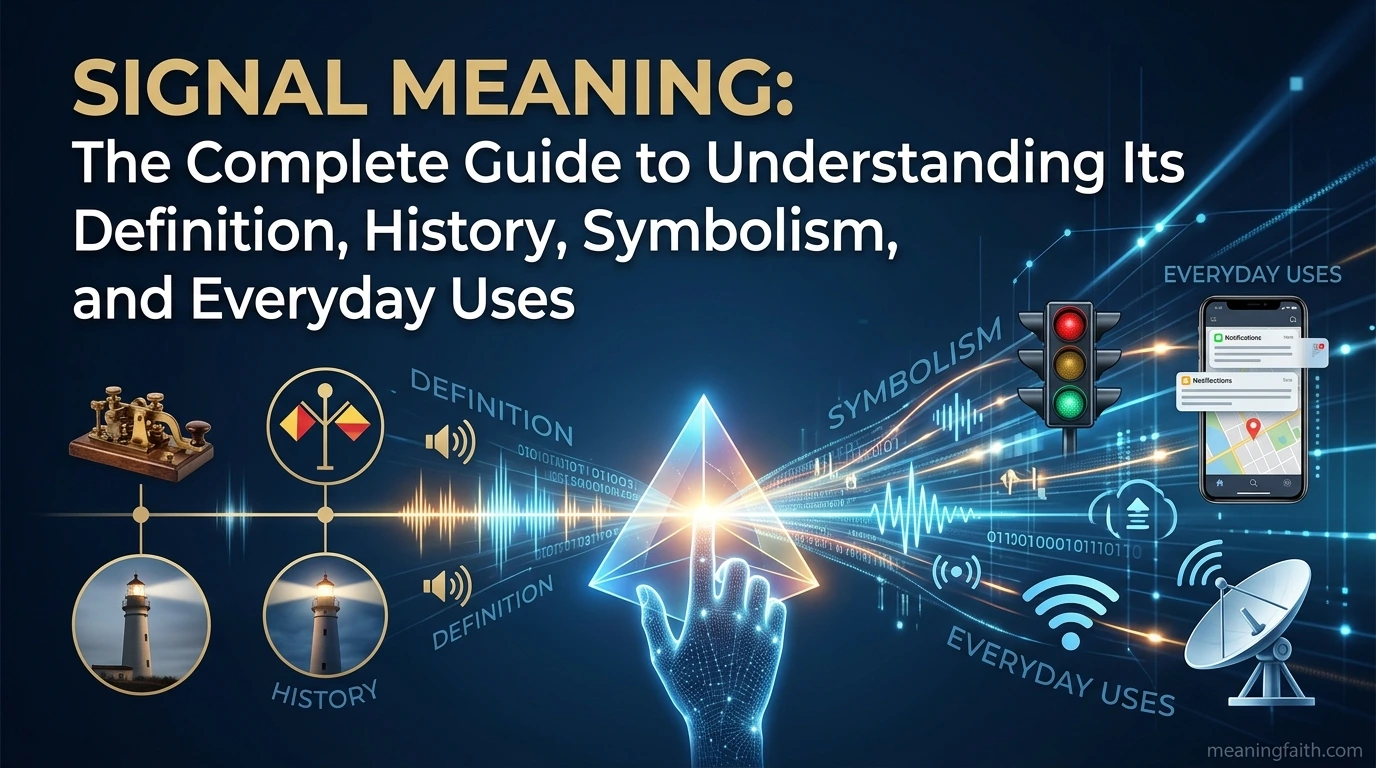
Signal meaning refers to the significance or message conveyed through a signal, whether it is visual, audible, digital, or behavioral. People encounter signals every day, from a traffic signal directing vehicles to stop or go, to a subtle gesture communicating emotions without words. In fields like communication, linguistics, and telecommunications, signals play an essential role in transferring information accurately and efficiently.
The concept of signal meaning goes far beyond technology. A simple hand wave, a flashing light, or even silence can function as a signal depending on the situation. Understanding what a signal means requires considering the sender, the receiver, and the surrounding context. This is why the same signal may carry different meanings in different cultures or environments.
Whether you are exploring the word for academic purposes, everyday conversation, psychology, or communication systems, learning about signal meaning helps you recognize how humans and machines exchange information. This guide explains its history, primary meanings, cultural significance, practical applications, and common misunderstandings.
signal meaning means: A signal meaning is the message, instruction, warning, or information communicated through a signal. A signal can be visual, audible, physical, or electronic, and its meaning depends on the agreed interpretation between the sender and receiver. In communication systems, signals help transmit information clearly and efficiently.
Origin & History of signal meaning
The idea behind signal meaning has existed for thousands of years. Long before modern technology, people relied on smoke, fire, drums, flags, horns, and hand gestures to communicate across long distances. These early methods were designed to transmit messages quickly when spoken language was impossible or impractical.
The English word signal comes from the Late Latin word signalis, meaning “serving as a sign.” It developed from the Latin root signum, which means “mark,” “token,” or “symbol.” This linguistic origin explains why signals have always been closely connected with signs and meaningful communication.
As civilizations expanded, more organized signaling systems emerged. Ancient military forces used flags and horns to coordinate troop movements. Maritime navigation introduced standardized flag signals that allowed ships from different nations to communicate despite language differences.
During the nineteenth century, signal systems advanced dramatically with the invention of Morse code and the electric telegraph. Samuel Morse’s system transformed communication by allowing messages to travel across continents almost instantly through coded electrical signals. This development changed commerce, journalism, transportation, and government communication.
Another major milestone came with the study of information theory in the twentieth century. American mathematician and engineer Claude Shannon established the mathematical foundation of digital communication. His work explained how signals carry information, how noise affects transmission, and how messages can be encoded efficiently.
Today, signal meaning applies to far more than physical communication. It includes digital data, wireless networks, social interactions, biological processes, and even financial markets. Although technology has evolved, the basic principle remains unchanged: a signal exists to communicate meaningful information from one source to another.
Primary Meaning of signal meaning
The primary meaning of signal meaning is the interpretation of information conveyed through a signal. A signal itself is simply a carrier of information. Its meaning comes from the agreed understanding between those sending and receiving it.
In everyday life, signals help people make decisions quickly. A green traffic light tells drivers to proceed, while a red light instructs them to stop. Emergency sirens warn communities of potential danger. School bells indicate the beginning or end of classes. These examples show how signal meaning depends on widely accepted rules.
In communication studies, signals are considered vehicles for transferring messages. The receiver interprets the signal based on shared knowledge, previous experience, and environmental context. Without shared understanding, even a perfectly transmitted signal may fail to communicate its intended meaning.
Signal meaning also plays a central role in technology. Mobile phones, radios, satellites, and internet connections all depend on electrical or electromagnetic signals. These signals carry voice, images, videos, and data by converting information into forms that machines can process and transmit.
In linguistics, spoken words themselves are signals. Sounds become meaningful because speakers of the same language agree on what they represent. Similarly, gestures such as nodding or waving function as nonverbal signals with recognizable meanings.
Psychologists also study signal meaning in human behavior. Facial expressions, eye contact, body posture, and tone of voice often communicate emotions more effectively than spoken words. These behavioral signals provide valuable information during social interaction.
Ultimately, signal meaning always combines three essential elements:
- A sender who creates the signal.
- A signal that carries information.
- A receiver who interprets the message.
Without any one of these components, communication becomes incomplete or ineffective.
Cultural Meanings of signal meaning
The meaning of a signal is not always universal. While some signals are standardized around the world, others are deeply influenced by culture, tradition, and local customs. Understanding these cultural differences helps prevent misunderstandings and improves communication between people from different backgrounds.
One clear example is the use of hand gestures. A thumbs-up is generally understood as a sign of approval in many Western countries. However, in some regions, the same gesture has historically carried a rude or offensive meaning. Similarly, eye contact is viewed as a sign of confidence and honesty in many cultures, while in others, prolonged eye contact may be interpreted as disrespectful.
Color also affects signal meaning. A white flag is widely recognized as a signal of surrender or a request for peace under international conventions. Red often signals danger, warning, or urgency, while green commonly represents safety, permission, or progress. Even these associations can vary depending on cultural traditions and historical influences.
Traditional ceremonies also use signals to communicate important messages. Temple bells, church bells, ceremonial drums, and conch shells have long been used to gather communities, announce significant events, or mark moments of worship. These sounds function as signals whose meanings are understood within a shared cultural context.
International travel has increased the importance of standardized signals. Road signs, airport symbols, emergency exits, and safety icons are designed to communicate without relying on language. Organizations such as the International Organization for Standardization (ISO) have developed many globally recognized symbols to reduce confusion across countries.
Although technology has made communication more consistent worldwide, local customs still shape how signals are interpreted. Learning these cultural meanings reminds us that effective communication depends not only on sending a signal but also on understanding how others are likely to receive it.
Spiritual / Religious Meaning
In many religious and spiritual traditions, signals are viewed as messages that encourage reflection, guidance, or awareness rather than simple physical indicators. Their meaning often depends on belief systems, sacred texts, and personal interpretation.
In Christianity, believers may interpret certain events as signs of God’s guidance or reminders of faith. The Bible frequently mentions signs that reveal divine purpose, encourage trust, or confirm important events. Rather than predicting the future, these signs are generally understood as strengthening spiritual understanding.
In Islam, natural events and the wonders of creation are described as ayah, a word that can also mean “sign.” These signs encourage believers to reflect on the power, wisdom, and mercy of God. The Qur’an repeatedly invites people to observe the world carefully as evidence of divine creation.
In Hinduism and Buddhism, spiritual signals may appear through rituals, meditation, symbols, or meaningful experiences. Sacred sounds, temple bells, lotus flowers, and traditional gestures often carry symbolic meanings connected to inner growth, wisdom, or compassion.
Many Indigenous cultures also recognize natural signals from animals, weather patterns, seasons, and landscapes. These observations often guide agriculture, ceremonies, hunting practices, and community traditions developed over centuries.
Modern spirituality sometimes interprets repeated numbers, meaningful coincidences, or recurring life experiences as personal signals. While these interpretations may provide comfort or inspiration, they are based largely on individual belief rather than scientific evidence.
Across religions and spiritual traditions, the central idea remains consistent: a signal is meaningful when it encourages reflection, wisdom, ethical action, or a deeper understanding of life.
Slang / Modern Usage
In modern conversation, signal meaning has expanded beyond its traditional definition. People now use the word “signal” metaphorically to describe clues, hints, or indicators in everyday life, especially in relationships, social media, business, and popular culture.
For example, someone might say, “That’s a strong signal,” when referring to behavior that clearly reveals another person’s intentions. In dating, friends often discuss whether someone is “sending signals” through eye contact, text messages, compliments, or body language. These signals are not official messages but subtle forms of communication that people interpret based on context.
Social media has also introduced new types of digital signals. Likes, shares, comments, and reactions can all function as signals of approval, disagreement, popularity, or engagement. Although these actions are simple, users often assign deeper meanings to them.
In business, market analysts frequently refer to economic signals. Rising employment, changing consumer spending, or interest rate adjustments may signal future economic trends. Investors use these indicators to make informed decisions rather than relying on guesses.
Sports commentators also use the word in everyday language. A coach may signal a tactical change, while a player’s actions may signal confidence or frustration before a competition.
Common modern uses include:
- Sending mixed signals in relationships.
- Giving clear signals during negotiations.
- Reading social signals in conversations.
- Recognizing warning signals before problems grow.
- Interpreting market signals in finance.
These modern expressions show that signal meaning has evolved from physical communication into a broader concept describing any observable clue that helps people understand intentions, Context-Based Meanings of signal meaning
The interpretation of a signal changes depending on the setting in which it appears. Although the basic idea remains the same—a signal communicates information—its meaning can vary greatly across different fields. Understanding the context helps avoid confusion and ensures the message is interpreted correctly.
In Communication
In communication, a signal is any medium that carries information from a sender to a receiver. This may include spoken words, written text, body language, sounds, or digital transmissions. The signal itself is only part of the communication process; the receiver must correctly interpret it for the message to be understood.
For example, a ringing telephone signals an incoming call, while a raised hand in a classroom signals a desire to speak. Effective communication depends on clear signals and shared understanding between participants.
In Technology and Telecommunications
In technology, a signal is an electrical, optical, or electromagnetic representation of information. Mobile phones, television broadcasts, Wi-Fi networks, and satellites all rely on signals to transmit voice, images, and data.
Engineers measure characteristics such as signal strength, frequency, and quality to ensure reliable communication. A weak signal may result in dropped calls or slow internet speeds, while a strong signal supports faster and more accurate data transfer.
In Psychology
Psychologists study signals as indicators of emotions, intentions, and social behavior. Facial expressions, eye movements, tone of voice, and posture all communicate information beyond spoken language.
For instance, crossed arms may signal discomfort or defensiveness in one situation but simply indicate that someone feels cold in another. This demonstrates why psychological signals should always be interpreted alongside the surrounding circumstances.
In Biology
In biology, signals allow living organisms to coordinate essential functions. Hormones act as chemical signals that regulate growth, metabolism, reproduction, and immune responses. Nerve cells transmit electrical signals that enable movement, sensation, and thought.
Plants also use signaling systems. Some release chemical compounds when attacked by insects, warning nearby plants to activate their own defenses. These biological signals illustrate that communication exists throughout nature, not only among humans.
In Business and Economics
Economists use the term signal to describe information that influences decisions. Rising inflation, declining unemployment, or increasing consumer confidence can all signal changes in the economy.
Businesses also send signals through pricing, branding, advertising, and product launches. A luxury brand, for example, may intentionally set higher prices to signal quality and exclusivity.
By examining these different contexts, it becomes clear that signal meaning is highly adaptable. The core principle—communicating useful information—remains constant even as the application changes across disciplines.
situations, or future developments.
Color / Design / Style Variations

Colors and design elements often strengthen signal meaning by making messages easier to recognize and interpret. Across transportation, safety, branding, and digital interfaces, color serves as an immediate visual cue that helps people respond quickly without reading detailed instructions.
Red is one of the most widely recognized signaling colors. It commonly represents danger, emergency, prohibition, or the need to stop. Stop signs, fire alarms, warning labels, and emergency buttons frequently use red because it attracts attention rapidly.
Green usually communicates safety, permission, or success. Traffic lights, emergency exit signs, and confirmation messages on websites often use green to indicate that an action is allowed or has been completed successfully.
Yellow typically signals caution. Construction signs, wet floor warnings, and hazard labels rely on yellow to alert people to potential risks without indicating immediate danger.
Blue often represents information, guidance, or mandatory instructions. Hospitals, airports, and public transportation systems frequently use blue signs to direct visitors or provide important notices.
Beyond color, design also influences signal meaning. Shapes help communicate messages even before words are read. Examples include:
- Circular signs often indicate mandatory actions or regulations.
- Triangular signs commonly warn about hazards or potential danger.
- Square and rectangular signs usually provide information or directions.
- Octagonal signs are strongly associated with stopping because of their unique shape.
Digital design follows similar principles. Notification badges, progress bars, icons, and status indicators act as visual signals that guide users through websites and mobile applications. Designers carefully combine colors, symbols, and typography to create interfaces that people can understand quickly.
Accessibility is another important consideration. Designers increasingly avoid relying only on color because individuals with color vision deficiencies may interpret signals differently. Combining colors with icons, labels, and patterns creates clearer communication for everyone.
Overall, color and design enhance signal meaning by making messages more noticeable, memorable, and universally understandable.
Common Misconceptions About signal meaning
Although signals are part of everyday life, several misconceptions can lead to incorrect interpretations. Understanding these misunderstandings helps improve communication and reduces confusion.
One common misconception is that every signal has only one fixed meaning. In reality, context plays a significant role. A flashing light on a vehicle may indicate a turn, a hazard, or an emergency depending on the situation.
Another misunderstanding is that signals are always intentional. While many signals are deliberately sent, others are unintentional. Nervous body language, changes in voice, or facial expressions can communicate feelings even when a person does not intend to send a message.
Some people believe that all cultures interpret signals in the same way. As discussed earlier, gestures, colors, and symbols often carry different meanings across societies. Assuming universal understanding can result in miscommunication.
Another myth is that technology eliminates misunderstanding. Even digital signals can be affected by interference, software errors, or human interpretation. A poor internet connection, corrupted data, or ambiguous notification may fail to communicate the intended message accurately.
People also sometimes confuse a signal with evidence. For example, an economic indicator may signal a possible future trend, but it does not guarantee that the outcome will occur. Similarly, behavioral signals in psychology suggest possibilities rather than proving someone’s intentions.
Finally, many assume stronger signals are always more reliable. In practice, reliability depends on clarity, consistency, and accurate interpretation—not simply on how noticeable the signal appears.
Recognizing these misconceptions allows people to evaluate signals more carefully and make better-informed decisions in daily life, work, and communication.
How to Use signal meaning in a Sentence
Learning how to use signal meaning correctly becomes easier by seeing it in everyday examples. The phrase is commonly used when discussing communication, technology, psychology, education, and symbolism. In each case, it refers to understanding what a particular signal communicates.
Here are some natural examples:
- “The teacher explained the signal meaning behind the classroom bell so new students would know when lessons begin and end.”
- “Understanding the signal meaning of traffic lights helps drivers travel safely and follow road rules.”
- “The researcher analyzed the signal meaning of participants’ facial expressions during the psychology experiment.”
- “Engineers improved the wireless network after discovering that poor signal quality affected data transmission.”
- “The historian described how military flags carried different signal meanings during naval battles.”
You may also hear similar expressions in everyday conversation:
- “Her smile was a positive signal.”
- “The market is sending mixed signals.”
- “His body language gave a clear signal that he was uncomfortable.”
- “The warning alarm signaled everyone to leave the building.”
- “The strong Wi-Fi signal improved the video call.”
When using the phrase, remember that the meaning always depends on context. A signal can represent a warning, instruction, invitation, emotion, or piece of information. Choosing the appropriate context makes your writing and speech more accurate and easier to understand.
Frequently Asked Questions About signal meaning
What does signal meaning mean?
Signal meaning refers to the message, instruction, or information communicated through a signal. The signal may be visual, audible, physical, digital, or behavioral. Its meaning depends on how the sender intends it to be understood and how the receiver interprets it within a specific context.
What is the origin of signal meaning?
The word “signal” comes from the Late Latin signalis, which is derived from signum, meaning “mark” or “sign.” Throughout history, signals have evolved from smoke, flags, and drums to modern electronic communication systems, while always serving the same purpose of conveying information.
What does signal meaning mean in communication?
In communication, signal meaning describes the information carried from a sender to a receiver. Signals can include spoken language, written text, gestures, sounds, or electronic transmissions. Successful communication occurs when both parties interpret the signal in the same intended way.
Is signal meaning positive or negative?
Signal meaning is neither inherently positive nor negative. A signal simply communicates information. Depending on the situation, it may represent a warning, encouragement, approval, danger, opportunity, or request. The surrounding context determines whether its meaning is viewed positively or negatively.
What is the difference between signal and symbol?
A signal is designed to communicate information or prompt an action, often immediately. A symbol, on the other hand, represents an idea, concept, or object and may carry broader cultural or emotional significance. While both convey meaning, signals are generally more action-oriented than symbols.
What does signal meaning symbolize?
Signal meaning symbolizes communication, awareness, and the transfer of information. Whether through technology, body language, or visual signs, signals help people and systems exchange messages efficiently. They also represent connection, coordination, and informed decision-making in everyday life.
Why do people use signals?
People use signals to share information quickly and clearly, especially when spoken language is impractical or insufficient. Signals improve safety, coordinate activities, express emotions, guide behavior, and enable communication between individuals, organizations, machines, and even biological systems.
Related Searches & Topics
Many people searching for signal meaning also want to understand the difference between a signal and a sign. A signal is primarily intended to communicate information or prompt an action, while a sign often identifies, represents, or provides information. Although the terms are related, a signal is usually more immediate and action-oriented.
Another common search is signal meaning in psychology. In psychology, signals include facial expressions, gestures, posture, eye contact, and tone of voice. These nonverbal cues help people understand emotions, intentions, and social interactions, often communicating more than spoken words alone.
Users also look for signal meaning in technology. In telecommunications and computer networks, signals carry voice, video, and digital data between devices. Engineers evaluate signal strength, frequency, bandwidth, and quality to maintain reliable communication and minimize interference.
A popular related topic is signal vs. noise. In information theory, a signal contains useful information, while noise refers to unwanted interference that reduces clarity. This distinction, introduced through the work of Claude Shannon, remains fundamental in modern communication systems and data science.
Many readers are interested in traffic signal meaning because traffic lights and road signals are among the most familiar examples of signaling systems. Their standardized colors and symbols help drivers, cyclists, and pedestrians make safe decisions while reducing accidents and improving traffic flow.
Conclusion
Signal meaning is the interpretation of information conveyed through a signal, whether it appears as a visual sign, spoken message, electronic transmission, or human behavior. From ancient smoke signals and Morse code to modern wireless communication and body language, signals have always helped people exchange information quickly and effectively.
Their interpretation depends on context, shared understanding, and cultural background, making them an essential part of communication, technology, psychology, and everyday life.
Understanding signal meaning allows us to recognize messages more accurately, avoid misunderstandings, and appreciate how information is transmitted across different situations. Whether you encounter signals on the road, in digital devices, or through personal interactions, their purpose remains the same: to communicate meaning clearly.

Daniel Matthews is a Bible researcher and Christian writer with a passion for explaining biblical terms, names, symbols, and theological concepts in simple language. He specializes in Old Testament studies, Hebrew word meanings, and biblical symbolism, helping readers better understand Scripture and its historical context.