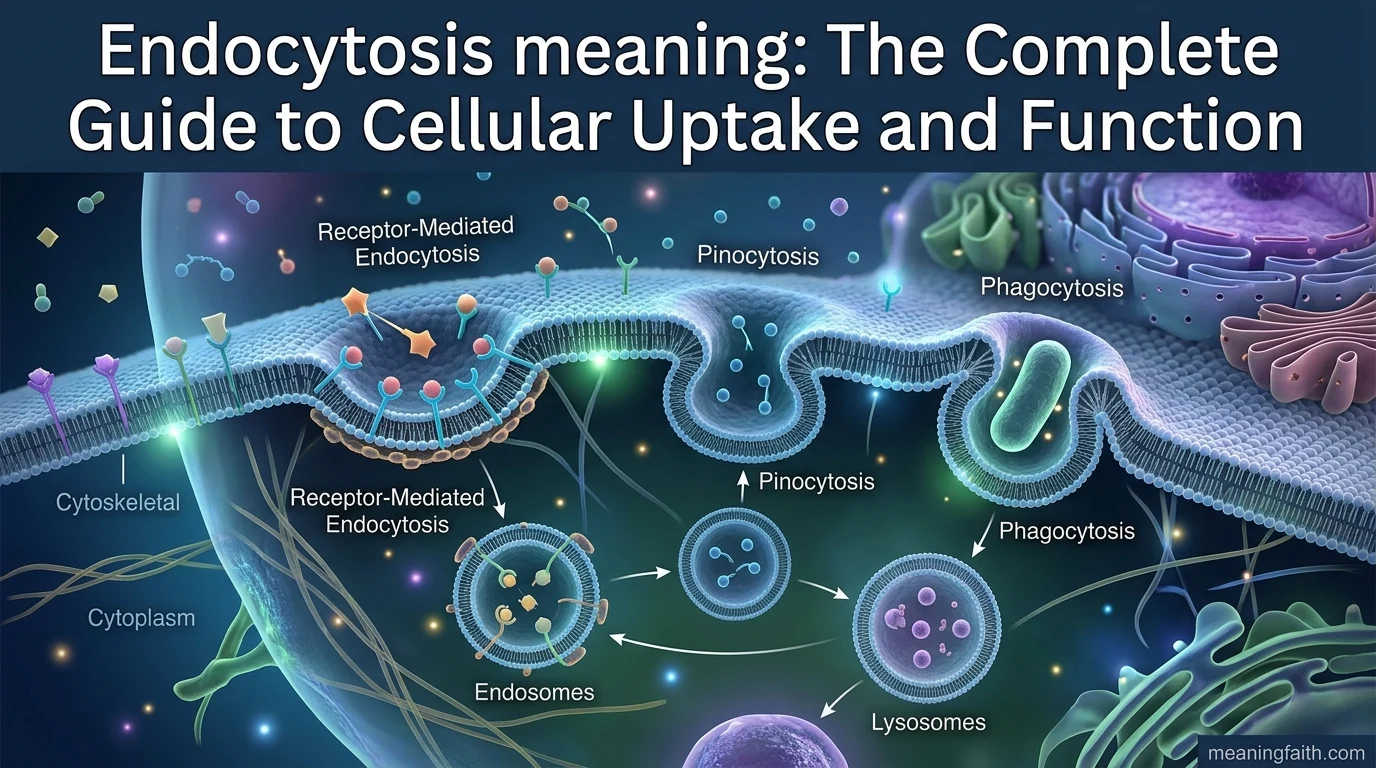
Endocytosis meaning refers to the process by which a cell takes in materials from outside its surface by surrounding them with part of its cell membrane and forming an internal vesicle. This biological process allows living cells to absorb nutrients, regulate communication signals, and remove unwanted substances. From simple organisms to complex humans, endocytosis is essential for survival.
Cells constantly interact with their surroundings. The cell membrane, also called the plasma membrane, acts as a selective barrier that controls what enters and leaves the cell. Through endocytosis, cells can bring in molecules such as proteins, nutrients, and signaling chemicals while maintaining internal balance.
Scientists in molecular biology study endocytosis because it connects many important cellular activities, including immune responses, communication between cells, and disease processes. Structures such as vesicles and lysosomes help manage these incoming materials after they enter the cell.
Understanding this process makes it easier to understand how cells function, adapt, and respond to changes in their environment.
endocytosis meaning means: Endocytosis is the cellular process where a cell membrane folds inward to capture substances outside the cell and creates a vesicle that transports those materials inside. It helps cells absorb nutrients, control signals, remove particles, and maintain normal biological functions.
Origin & History of endocytosis meaning
The concept behind endocytosis developed as scientists improved their understanding of how cells exchange materials with their environment. Early cell researchers observed that cells were not passive structures but active systems capable of moving substances across their boundaries.
The term “endocytosis” comes from Greek roots. “Endo” means “within” or “inside,” while “cytosis” relates to cells. Together, the word describes a process involving movement into a cell.
Modern discoveries about endocytosis expanded during the 20th century with advances in microscopy and cell biology. Researchers discovered that the plasma membrane could bend, surround external materials, and create internal compartments.
Scientists such as Thomas Rothstein contributed to research on membrane transport and cellular processes. Later discoveries showed that endocytosis was not a single mechanism but a group of related pathways.
Today, organizations such as the National Institutes of Health support research into endocytosis because it plays roles in areas including infection, medicine delivery, and human health. The history of this concept shows how scientists moved from observing cells under microscopes to understanding complex molecular systems.
Primary Meaning of endocytosis meaning
The primary meaning of endocytosis is the active process where a cell absorbs material from its external environment. Instead of allowing substances to freely pass through the cell membrane, the cell uses energy to surround and transport selected materials inward.
During endocytosis, the plasma membrane changes shape and creates a pocket around the substance being captured. This pocket eventually closes and becomes a vesicle inside the cell.
The main steps include:
- The cell identifies a substance outside its membrane.
- The membrane surrounds the substance.
- A vesicle forms and moves into the cytoplasm.
- The material is processed, stored, or transported.
Endocytosis helps cells perform important tasks. For example, human cells use it to absorb nutrients and regulate receptors on their surfaces. Immune cells use related processes to capture foreign particles.
The process differs from simple diffusion because it requires cellular energy. It is a controlled biological mechanism rather than a random movement of molecules.
Types of Endocytosis
Endocytosis includes several pathways that allow cells to capture different types of materials. Each pathway has a specific role depending on the size and nature of the substance entering the cell.
Phagocytosis
Phagocytosis is often called “cell eating.” In this process, specialized cells surround large particles such as bacteria or damaged cellular material.
Immune cells, including macrophages, use phagocytosis as part of the body’s defense system. They capture unwanted particles and transport them into internal compartments where they can be broken down.
Pinocytosis
Pinocytosis is sometimes called “cell drinking.” It involves the intake of small amounts of surrounding fluid and dissolved substances.
Many cells use pinocytosis continuously to sample their environment. Unlike phagocytosis, it usually involves smaller particles and fluid rather than large objects.
Receptor-Mediated Endocytosis
Receptor-mediated endocytosis is a highly selective form of uptake. Cells use specific receptors on their membrane to recognize certain molecules.
This method allows cells to collect important substances efficiently. For example, cells can use receptors to take in specific proteins or hormones.
Cultural Meanings of endocytosis meaning
Unlike words connected to traditions, symbols, or social identity, endocytosis does not have cultural meanings in the usual sense. It is a scientific term used internationally in biology, medicine, and education.
However, different cultures have contributed to the study and teaching of cellular science. Universities, laboratories, and medical institutions around the world explain endocytosis as a fundamental part of life science.
In countries with strong biomedical research traditions, such as the United States, Germany, Japan, and the United Kingdom, endocytosis is widely studied in fields including genetics and medicine.
The broader cultural meaning of endocytosis comes from how humans understand life itself. The process demonstrates that living systems are organized, adaptable, and constantly interacting with their surroundings.
In education, learning about endocytosis helps students connect microscopic cellular activity with larger topics such as health, immunity, and disease.
Spiritual / Religious Meaning (if applicable)
Endocytosis does not have a recognized spiritual or religious meaning because it is a scientific term describing a physical process inside cells.
Some people may use biological concepts as personal reflections about life, connection, or organization. For example, the ability of cells to communicate and maintain balance may inspire philosophical thoughts about nature.
However, these interpretations are personal rather than part of biology. Scientific explanations of endocytosis focus on observable mechanisms involving membranes, vesicles, and cellular structures.
Religious traditions generally do not define endocytosis itself because the term belongs to modern biology. Its meaning comes from laboratory research rather than spiritual texts or religious practices.
Slang / Modern Usage (if applicable)
Endocytosis is not commonly used as slang in everyday conversation. It remains a technical biology term mainly used by students, researchers, healthcare professionals, and science educators.
On social media and educational platforms, people may mention endocytosis when discussing biology lessons, science exams, or health topics. In these situations, the term keeps its scientific meaning.
Some online discussions simplify endocytosis by comparing it to a cell “eating” or “drinking.” These descriptions are useful teaching tools but are not literal meanings.
Because the word is specialized, it usually appears in academic contexts rather than casual speech. Its modern usage remains connected to science communication and education.
Context-Based Meanings of endocytosis meaning
The meaning of endocytosis can change slightly depending on the context in which it is discussed.
Biology classroom context
In classrooms, endocytosis usually refers to a basic cellular transport process. Teachers explain how cells bring substances inside through membrane movement.
Medical research context
In medicine, researchers study endocytosis because it affects how cells respond to medicines, viruses, and signaling molecules. Understanding these pathways can help scientists develop treatments.
Molecular biology context
In molecular biology, endocytosis refers to detailed interactions between proteins, receptors, membranes, and vesicles. Scientists examine how these tiny mechanisms control cell behavior.
Immune system context
In immunology, endocytosis connects to how immune cells capture and process foreign materials. Phagocytosis is especially important in this area.
Across these contexts, the central idea remains the same: cells use controlled membrane processes to bring materials inside.
Color / Design / Style Variations (if applicable)

Endocytosis does not have color, design, or style meanings because it is not a symbol, artwork, or visual object. However, scientific illustrations often use colors to represent different cellular parts.
In biology diagrams:
- The cell membrane may be shown as a colored boundary.
- Vesicles may appear as small circles inside the cell.
- The cytoplasm may be displayed as a background area.
- The nucleus and other organelles may have separate colors.
These colors are design choices used for learning and communication. They do not represent different meanings of endocytosis.
Scientific animations often show the membrane folding inward to help students visualize the process. These visual tools make a microscopic event easier to understand.
Common Misconceptions About endocytosis meaning
Several misunderstandings exist about endocytosis. One common mistake is believing that endocytosis is simply a cell opening a door and letting materials enter. In reality, the cell actively changes its membrane structure and uses energy.
Another misconception is that all endocytosis pathways work the same way. Different forms, including phagocytosis, pinocytosis, and receptor-mediated endocytosis, have different functions.
Some people also confuse endocytosis with exocytosis. Endocytosis moves materials into a cell, while exocytosis moves materials out of a cell through vesicle release.
Another misunderstanding is that only animal cells use endocytosis. Many types of cells perform similar uptake processes, although the details vary between organisms.
Understanding these differences helps create a more accurate picture of cellular life.
How to Use endocytosis meaning in a Sentence
Here are examples of how the term can be used:
- “The biology student researched endocytosis to understand how cells absorb external molecules.”
- “Scientists studied receptor-mediated endocytosis to learn how specific proteins enter cells.”
- “The immune system uses phagocytosis, a specialized form of endocytosis, to capture harmful particles.”
- “The professor explained that endocytosis allows the cell membrane to transport materials into the cytoplasm.”
- “Learning the endocytosis meaning helped the class understand how cells maintain balance.”
Frequently Asked Questions About endocytosis meaning
What does endocytosis meaning mean?
Endocytosis meaning describes the process where a cell takes substances from outside its surface and brings them inside by forming a vesicle from the cell membrane. It is an energy-dependent process used for nutrient absorption, communication, and cellular regulation.
What is the origin of endocytosis meaning?
The word endocytosis comes from Greek roots meaning “inside” and “cell process.” Scientists developed the term as cell biology advanced and researchers discovered that cells could actively transport materials through membrane changes.
What does endocytosis mean in biology?
In biology, endocytosis refers to the movement of materials into a cell through membrane folding and vesicle formation. It includes processes such as phagocytosis, pinocytosis, and receptor-mediated endocytosis.
Is endocytosis positive or negative?
Endocytosis is neither positive nor negative. It is a necessary cellular function. Cells depend on it for normal activities such as nutrient intake, communication, and immune protection.
What is the difference between endocytosis and exocytosis?
Endocytosis moves materials into a cell by creating vesicles from the membrane. Exocytosis does the opposite by using vesicles to release substances outside the cell.
What does endocytosis symbolize?
Endocytosis does not symbolize anything in a cultural or spiritual sense. Scientifically, it represents cellular organization, adaptation, and the ability of living systems to interact with their environment.
Related Searches & Topics
A common related search is “endocytosis vs exocytosis.” This topic compares how cells move materials in opposite directions and helps learners understand cellular transport systems.
Another related query is “types of endocytosis.” This search usually focuses on phagocytosis, pinocytosis, and receptor-mediated endocytosis and explains how cells choose different pathways.
People also search for “endocytosis function” to learn why cells need this process. The answer involves nutrient uptake, immune defense, and communication between cells.
The phrase “endocytosis process steps” is another common topic. It explores how the membrane forms a vesicle and how the cell manages incoming materials.
Students often search for “endocytosis diagram” because visual explanations make the movement of membranes and vesicles easier to understand.
Conclusion
Endocytosis meaning describes a vital cellular process in which cells bring outside materials into their interior using membrane movement and vesicle formation. Its major forms include phagocytosis, pinocytosis, and receptor-mediated endocytosis.
This process supports essential activities such as nutrient collection, immune defense, and communication between cells. Scientific research in molecular biology continues to reveal how important endocytosis is for health and disease.
By understanding how cells control what enters their boundaries, we gain a clearer view of the complexity of life at the microscopic level. Which meaning of endocytosis meaning resonates most with you?

Grace Anderson is a contributor at MeaningFaith.com who specializes in dream meanings, symbolism, and personal growth topics. She is dedicated to creating informative and reader-friendly content that helps people explore the deeper meanings behind everyday experiences and spiritual concepts.