The philippians 4 6-7 meaning centers on trusting God instead of giving in to anxiety. In these well-known verses, the Apostle Paul teaches believers to replace worry with prayer, thanksgiving, and complete dependence on God. The promise that follows is remarkable: God’s peace, which goes beyond normal human understanding, will guard the hearts and minds of those who trust in Jesus Christ.
For many Christians, Philippians 4:6–7 is more than a comforting Bible passage. It is practical guidance for handling fear, uncertainty, stress, and difficult circumstances. Whether someone is facing financial hardship, illness, relationship struggles, or everyday worries, these verses point toward a response rooted in faith rather than panic.
Written nearly two thousand years ago, Paul’s message remains one of the most quoted and memorized passages in the New Testament. Understanding its original context, spiritual meaning, and modern application reveals why these verses continue to encourage millions of people around the world.
philippians 4 6-7 means: believers should not let anxiety control their lives but instead bring every concern to God through prayer, thanksgiving, and honest requests. According to the Apostle Paul, those who trust God in this way receive the peace of God through Jesus Christ, a peace that protects both heart and mind even when circumstances remain difficult.
Origin & History of philippians 4 6-7 meaning
To fully understand the philippians 4 6-7 meaning, it helps to examine where these verses came from and why Paul wrote them. Philippians is one of the letters included in the New Testament and was written by the Apostle Paul while he was imprisoned, most likely in Rome around AD 60–62. Rather than focusing on his own suffering, Paul encouraged believers to live with joy, confidence, and unwavering faith.
The letter was addressed to Christians living in Philippi, a Roman colony in Macedonia. Philippi held special importance because it was the location of Paul’s first Christian church established in Europe during his second missionary journey. The church maintained a close relationship with Paul, supporting him both spiritually and financially.
When Paul instructed believers not to be anxious, he was not writing from a life of comfort. He personally experienced imprisonment, persecution, beatings, and uncertainty. His encouragement came from firsthand experience rather than theory. This historical background gives the passage greater depth because Paul’s confidence in God remained strong despite severe hardship.
The language used in the original Greek also adds richness to the passage. The word commonly translated as “anxious” carries the idea of being divided or pulled apart by worry. Paul contrasts this unhealthy state with prayer, thanksgiving, and confidence in God’s care.
Another significant historical detail is the military imagery in verse seven. The phrase “guard your hearts and your minds” describes the protective work of God’s peace like soldiers defending a city. Since Philippi was a Roman military colony, its residents would immediately understand this picture. Instead of relying only on Roman protection, Paul pointed believers toward the greater security found in God’s peace through Christ.
This historical setting explains why Philippians 4:6–7 continues to resonate with readers today. The message was written during hardship, addressed to people living in a Roman society, and grounded in genuine Christian faith rather than ideal circumstances.
Primary Meaning of philippians 4 6-7 meaning
The primary philippians 4 6-7 meaning is that God invites believers to exchange anxiety for trust through prayer. Rather than pretending life’s problems do not exist, Paul teaches Christians to respond to every concern by bringing it honestly before God.
Verse six contains three connected actions. First, believers are told not to become consumed by anxiety. Second, they are instructed to pray about every situation. Third, they should approach God with thanksgiving, remembering His faithfulness even before receiving an answer. These actions reflect a relationship built on confidence rather than fear.
Prayer in this passage is broader than simply asking for help. Paul mentions prayer, petition, and thanksgiving together. This combination highlights worship, specific requests, and gratitude. Instead of focusing only on problems, believers are encouraged to remember God’s character and previous blessings.
Verse seven describes the result of this lifestyle. Paul does not promise that every difficult circumstance will immediately disappear. Instead, he promises something even deeper: “the peace of God.” This peace is described as surpassing all understanding because it cannot always be explained by human logic. People may still face challenges, yet experience calm confidence through their faith in Jesus Christ.
The phrase “guard your hearts and your minds” is especially meaningful. The heart often represents emotions and desires, while the mind refers to thoughts and reasoning. Anxiety can disturb both emotional well-being and clear thinking. God’s peace provides protection for each, helping believers remain spiritually grounded during uncertainty.
Another important aspect of the passage is its balance between human responsibility and divine action. Believers actively choose prayer and thanksgiving, while God graciously provides peace. This partnership emphasizes faith expressed through daily dependence rather than passive waiting.
For Christians today, the primary meaning remains both practical and deeply spiritual. Instead of allowing worry to dominate every thought, believers are encouraged to place every concern into God’s hands. The result is not merely temporary comfort but an enduring peace rooted in God’s presence rather than changing circumstances.
Cultural Meanings of philippians 4 6-7 meaning
The philippians 4 6-7 meaning has influenced Christian culture for nearly two thousand years. Across different countries, denominations, and traditions, these verses are recognized as a source of hope during difficult times. They are frequently read during church services, funerals, weddings, hospital visits, and personal devotions because they remind believers that God offers peace even when life feels uncertain.
In many Christian communities, Philippians 4:6–7 is one of the first Bible passages children memorize. Parents, pastors, and teachers use it to explain that faith is not the absence of problems but the choice to trust God through them. This lesson has remained consistent from the early Christian Church to modern congregations around the world.
The passage is also commonly featured on greeting cards, home décor, journals, and artwork. Its popularity reflects how deeply its message resonates with everyday life. Whether someone is grieving, making a major decision, or facing unexpected challenges, these verses encourage turning to God instead of allowing fear to take control.
Different Christian traditions may emphasize different aspects of the passage. Protestant churches often focus on personal prayer and trusting God’s promises. Catholic teaching highlights prayer, thanksgiving, and participation in the life of the Church as ways believers grow in God’s peace. Orthodox Christians frequently connect these verses with continual prayer and inner spiritual stillness.
Despite these differences, the central message remains remarkably consistent. Across cultures and traditions, Philippians 4:6–7 teaches that God’s peace is available to believers who faithfully bring their concerns before Him.
Another cultural significance is the passage’s role during times of crisis. Throughout history—including periods of war, persecution, natural disasters, and economic hardship—Christians have turned to these verses for encouragement. Their enduring popularity demonstrates that the promise of God’s peace speaks to people regardless of language, nationality, or historical era.
Spiritual / Religious Meaning
The spiritual heart of the philippians 4 6-7 meaning is the invitation to deepen one’s relationship with God through trust. Rather than presenting prayer as a religious obligation, Paul describes it as an ongoing conversation with a loving Father who cares about every detail of life.
The command, “Do not be anxious about anything,” is not a condemnation of people who struggle with worry. Instead, it is an invitation to redirect anxious thoughts toward God. Scripture acknowledges that believers experience fear, sadness, and uncertainty, but it consistently encourages bringing those emotions honestly before God.
Thanksgiving plays an essential role in this passage. Gratitude shifts attention from what is lacking to what God has already provided. Even while waiting for answers, believers remember God’s faithfulness in the past, strengthening their confidence for the future.
The “peace of God” differs from ordinary peace. Human peace often depends on favorable circumstances. Biblical peace remains steady because it is rooted in God’s unchanging character rather than changing situations. This peace does not ignore hardship; instead, it enables believers to endure hardship with hope.
Many Bible scholars also observe that Paul carefully distinguishes between praying occasionally and making prayer a continual pattern. Every concern, large or small, becomes an opportunity to depend on God. This develops spiritual maturity over time.
The phrase “through Christ Jesus” is equally important. According to Christian teaching, lasting peace comes through a relationship with Jesus Christ. His death and resurrection restored humanity’s relationship with God, making genuine spiritual peace possible.
The Holy Spirit is also understood to work through this promise. While Philippians 4 does not explicitly mention the Holy Spirit in these verses, the New Testament consistently teaches that God’s Spirit comforts, guides, and strengthens believers. Many Christians therefore see God’s peace as evidence of the Spirit’s ongoing work within them.
Ultimately, the spiritual meaning extends beyond emotional comfort. It points believers toward greater faith, deeper dependence on God, and confidence that His presence remains constant regardless of life’s circumstances.
Context-Based Meanings of philippians 4 6-7 meaning
Personal Life
In everyday life, the philippians 4 6-7 meaning encourages believers to respond to ordinary worries with prayer instead of allowing fear to dominate their thinking. Concerns about finances, family, health, education, or the future become opportunities to practice trust. The passage teaches that peace is not earned by solving every problem but received by bringing every concern before God.
During Times of Suffering
These verses take on special significance during seasons of hardship. People experiencing illness, grief, unemployment, or uncertainty often find comfort in Paul’s promise that God’s peace can exist alongside suffering. Importantly, Paul himself wrote these words while imprisoned, making his encouragement especially credible. His example demonstrates that peace does not require perfect circumstances.
In Christian Worship and Devotion
Philippians 4:6–7 is regularly used in sermons, Bible studies, prayer meetings, and devotional reading. Churches often include the passage during services focused on hope, encouragement, or healing. Individual believers may meditate on these verses during quiet prayer, using them as a reminder to surrender worries to God each day.
Mental and Emotional Well-Being
Many people also apply these verses while managing stress and emotional pressure. Within Christian teaching, the passage encourages healthy spiritual practices such as prayer, gratitude, and trust. At the same time, many pastors and Christian counselors emphasize that seeking medical or professional mental health support is fully compatible with faith. Prayer and appropriate treatment can work together rather than replacing one another.
Common Misconceptions About philippians 4 6-7 meaning
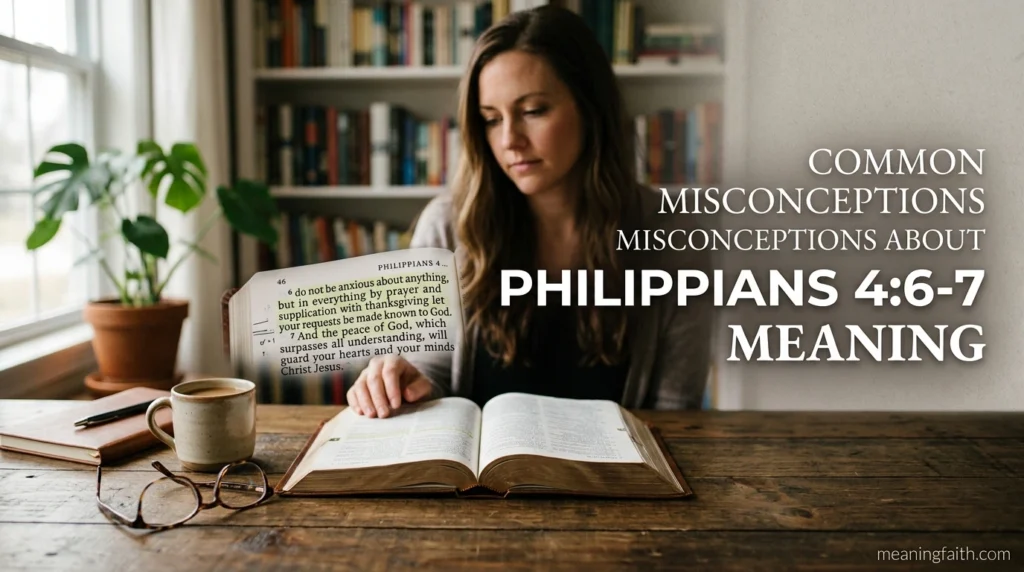
One common misunderstanding is that Paul commands believers to simply stop worrying through sheer willpower. In reality, the passage provides a positive alternative rather than a simplistic command. Instead of suppressing anxiety, believers are invited to redirect it through prayer, thanksgiving, and trust in God.
Another misconception is that these verses promise an immediate solution to every problem. Paul never guarantees that difficult situations will disappear after prayer. The promise focuses on receiving God’s peace while walking through those circumstances. External conditions may remain unchanged even as the believer experiences inner calm.
Some readers mistakenly assume that Christians who experience anxiety lack faith. This interpretation overlooks the broader message of Scripture, where faithful individuals—including David, Elijah, and even Paul—experienced deep emotional struggles. Philippians 4:6–7 acknowledges human anxiety while pointing toward God’s sustaining presence.
Others interpret “peace that surpasses all understanding” as an emotional feeling that should always be present. Biblical peace is often deeper than emotion. It includes confidence, assurance, and trust that remain even when feelings fluctuate.
A final misconception is that thanksgiving means pretending everything is fine. Biblical gratitude does not ignore pain or hardship. Instead, it recognizes God’s faithfulness despite difficult circumstances. This balanced perspective allows believers to be honest about their struggles while remaining hopeful about God’s care.
How to Use philippians 4 6-7 meaning in a Sentence
Understanding the philippians 4 6-7 meaning becomes easier when it is used naturally in conversation or writing. Here are several examples:
- “After studying the philippians 4 6-7 meaning, I realized that Paul teaches believers to replace anxiety with prayer.”
- “The philippians 4 6-7 meaning reminds Christians that God’s peace is available even during uncertain seasons.”
- “Our Bible study explored the philippians 4 6-7 meaning by examining the historical setting in Philippi and Paul’s imprisonment.”
- “Many people find comfort in the philippians 4 6-7 meaning because it emphasizes trust in Jesus Christ instead of fear.”
- “The pastor explained the philippians 4 6-7 meaning as an invitation to pray with thanksgiving rather than becoming overwhelmed by worry.”
Frequently Asked Questions About philippians 4 6-7 meaning
What does philippians 4 6-7 meaning mean?
The philippians 4 6-7 meaning teaches that believers should respond to anxiety by bringing every concern to God through prayer, thanksgiving, and honest requests. In return, God promises His peace, which surpasses human understanding and guards both the heart and mind through Jesus Christ. The passage emphasizes trust in God rather than fear of uncertain circumstances.
What is the origin of philippians 4 6-7 meaning?
The meaning comes from the biblical book of Philippians in the New Testament. The Apostle Paul wrote this letter while imprisoned around AD 60–62 to encourage the Christian church in Philippi, a Roman colony in Macedonia. His own difficult circumstances give additional weight to his message about trusting God instead of giving in to anxiety.
What does philippians 4 6-7 mean in Christian life?
In everyday Christian life, these verses encourage believers to develop a habit of prayer whenever worries arise. Rather than allowing fear to dominate their thoughts, Christians are invited to rely on God’s guidance and remember His faithfulness with thanksgiving. The promised result is an inner peace that remains even when life’s challenges continue.
Is philippians 4 6-7 positive or negative?
The passage is overwhelmingly positive because it offers hope instead of despair. Although it acknowledges that anxiety is a real human experience, its primary focus is God’s provision of peace. The verses encourage believers to trust in God’s care and reassure them that His presence is greater than their fears.
What is the difference between philippians 4 6-7 and Matthew 6:34?
Both passages address worry, but they emphasize different truths. Matthew 6:34 records Jesus teaching His followers not to worry about tomorrow because God faithfully provides for their daily needs. Philippians 4:6–7, written later by Paul, explains how believers should respond to anxiety through prayer, thanksgiving, and trust, resulting in God’s peace.
What does philippians 4 6-7 symbolize?
These verses symbolize complete dependence on God. They represent exchanging fear for faith, replacing anxious thoughts with prayer, and experiencing divine peace that cannot be fully explained by human reasoning. They also symbolize God’s constant presence, protecting believers emotionally and spiritually through Jesus Christ.
Related Searches & Topics
Many readers who study the philippians 4 6-7 meaning also explore the broader message of the Book of Philippians. Throughout the letter, Paul repeatedly encourages believers to rejoice in the Lord, remain humble, and live with confidence despite difficult circumstances. These themes help explain why peace is such an important part of chapter four.
Another closely related search is the peace of God vs. peace with God. Peace with God refers to the restored relationship believers have through Jesus Christ, while the peace of God describes the inner calm and assurance that flow from that relationship. Understanding this distinction provides deeper insight into Paul’s teaching.
People also frequently search for how to overcome anxiety according to the Bible. Philippians 4:6–7 is one of several passages addressing this topic, alongside teachings found in the Psalms, Isaiah 41:10, 1 Peter 5:7, and the words of Jesus in Matthew 6. Together, these passages present prayer, faith, and trust as central responses to fear.
Another common topic is why thanksgiving matters in prayer. Paul deliberately joins gratitude with prayer because remembering God’s previous faithfulness strengthens confidence in His future care. Thanksgiving shifts attention away from fear and toward God’s unchanging character.
Many readers are also interested in Philippians 4:8, the verse immediately following this passage. After teaching believers how to pray, Paul instructs them to focus their minds on whatever is true, honorable, just, pure, lovely, and praiseworthy. This progression shows that trusting God also shapes the way believers think each day.
Conclusion
The philippians 4 6-7 meaning is a timeless reminder that believers are invited to replace anxiety with prayer, thanksgiving, and unwavering trust in God. Rooted in the historical setting of Paul’s imprisonment and the church at Philippi, these verses reveal that genuine peace does not depend on comfortable circumstances but on a confident relationship with Jesus Christ.
Their message has encouraged Christians across cultures and generations because it combines practical guidance with a profound spiritual promise: God’s peace will guard both the heart and the mind. Whether studied for personal devotion, biblical understanding, or daily encouragement, these verses continue to offer hope to those facing uncertainty.

Daniel Matthews is a Bible researcher and Christian writer with a passion for explaining biblical terms, names, symbols, and theological concepts in simple language. He specializes in Old Testament studies, Hebrew word meanings, and biblical symbolism, helping readers better understand Scripture and its historical context.