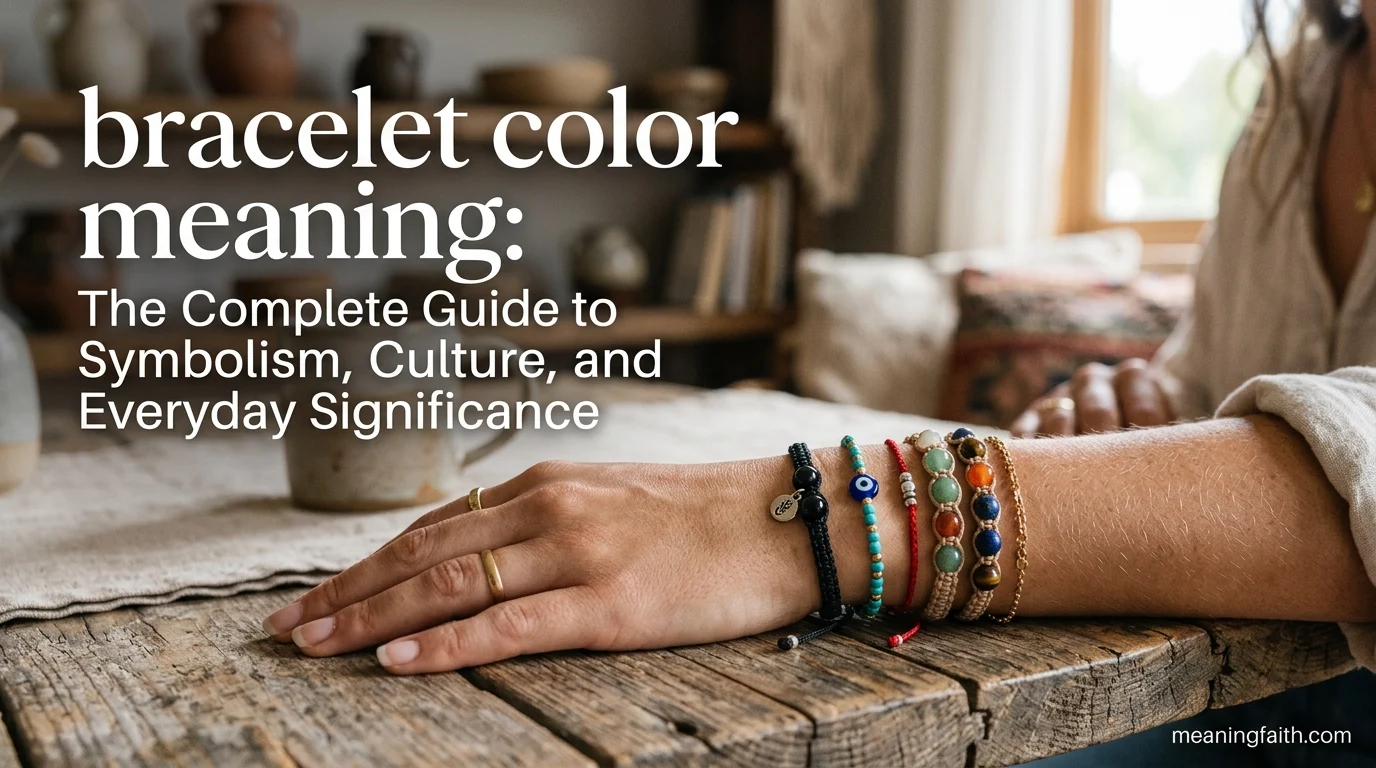
Bracelet color meaning refers to the symbolism, emotions, beliefs, or messages associated with the color of a bracelet. Whether worn as a fashion accessory, a friendship bracelet, a spiritual reminder, or an awareness ribbon, bracelet colors often communicate ideas without using words. Across cultures and traditions, colors have represented emotions, personality traits, healing practices, and religious beliefs, making bracelets more than simple pieces of jewelry.
People choose bracelet colors for many reasons. Some wear a green bracelet to symbolize growth or good luck, while others choose blue to express calmness or trust. In spiritual practices such as Buddhism and Hinduism, colored bracelets may represent protection, mindfulness, or devotion. Modern fashion has also expanded the meaning of bracelet colors, allowing people to express their identity, support social causes, or celebrate friendships.
Understanding bracelet color meaning helps you appreciate both the history behind these accessories and the personal stories they often represent. While some meanings are widely recognized, others depend on culture, religion, or individual interpretation.
bracelet color meaning means: the symbolic message or significance associated with the color of a bracelet. Different colors can represent emotions, beliefs, personality traits, spirituality, awareness causes, or relationships. The meaning often depends on cultural traditions, personal intention, and the purpose for which the bracelet is worn.
Origin & History of bracelet color meaning
The idea that colors carry symbolic meaning is much older than bracelets themselves. Ancient civilizations, including those in Egypt, China, India, and Greece, believed that colors influenced emotions, health, and spiritual well-being. Jewelry became one of the easiest ways to display these symbolic colors in everyday life.
Bracelets have been worn for thousands of years. Archaeologists have discovered bracelets made from shells, stones, copper, and precious metals dating back to prehistoric societies. These early bracelets often served practical purposes, but many also functioned as protective charms or symbols of social status.
As civilizations developed, colored materials became increasingly meaningful. Natural gemstones, dyed threads, beads, and woven fibers allowed people to create bracelets that represented specific beliefs. Ancient Egyptians associated green stones with rebirth, while red gemstones symbolized life and strength. In India, colorful bangles became connected with prosperity, marriage, and celebration.
Religious traditions also shaped bracelet symbolism. Prayer bracelets, meditation beads, and sacred threads introduced additional meanings connected to faith and devotion. In Christianity, certain bracelets feature colors that represent themes such as sacrifice, purity, or eternal life. In Buddhism, woven bracelets blessed by monks often symbolize compassion, protection, and mindfulness rather than luck alone.
Modern bracelet color meaning evolved further during the twentieth century. Friendship bracelets became popular among children and teenagers, while colored silicone bands and awareness bracelets helped raise support for charitable causes. Today, historical traditions and modern interpretations exist side by side, giving bracelet colors multiple layers of meaning.
Primary Meaning of bracelet color meaning
At its core, bracelet color meaning is about communication through color. A bracelet can express a person’s feelings, beliefs, goals, or values without requiring any spoken explanation.
Colors influence human psychology in subtle ways. Researchers studying color symbolism have found that people often associate particular colors with similar emotions, although interpretations can vary between cultures. Because of this, bracelets have become a simple way to express identity or intention.
Some commonly recognized meanings include:
- Red represents passion, courage, love, and energy.
- Blue symbolizes peace, honesty, trust, and emotional balance.
- Green often stands for growth, health, nature, and prosperity.
- Yellow is linked to happiness, optimism, and creativity.
- Black represents strength, sophistication, mystery, or remembrance.
- White symbolizes purity, hope, innocence, and new beginnings.
- Purple is associated with wisdom, spirituality, and imagination.
- Pink often represents kindness, affection, compassion, and friendship.
These meanings are not fixed rules. A person wearing a blue bracelet might simply enjoy the color, while someone else wears it as a reminder to stay calm during stressful situations.
The material of the bracelet also matters. A woven friendship bracelet carries different associations than a bracelet made with healing crystals or natural gemstones. Likewise, handmade bracelets often symbolize personal connection because someone invested time and care into creating them.
Ultimately, bracelet color meaning combines universal color symbolism with individual intention, allowing each bracelet to tell a unique story.
Cultural Meanings of bracelet color meaning
Different cultures have developed their own traditions surrounding colored bracelets, giving many colors meanings that extend far beyond fashion.
In India, colorful bracelets and bangles play an important role during weddings, festivals, and family celebrations. Red and green bangles are commonly associated with marriage, fertility, prosperity, and happiness. Gold-colored bracelets often symbolize wealth and blessings.
In parts of Latin America, newborn babies sometimes wear red string bracelets to help protect them from the “evil eye,” a traditional belief found in many Mediterranean and Middle Eastern cultures. Similar customs exist in Greece, Turkey, and other regions where protective jewelry has long been valued.
Friendship bracelets became especially popular in North America during the 1970s and 1980s. Woven from colorful embroidery thread, these bracelets symbolize loyalty, appreciation, and lasting friendships. According to tradition, the recipient should wear the bracelet until it naturally falls off, representing the endurance of the friendship.
In East Asian cultures, red continues to symbolize celebration, happiness, and good fortune. White, however, may be associated with mourning in some countries, making its meaning different from Western interpretations that emphasize purity and weddings.
Color symbolism also appears in national celebrations, local customs, and family traditions. A bracelet worn during a festival may represent cultural identity rather than personal emotion. Likewise, traditional beadwork created by Indigenous communities often uses color patterns that communicate ancestry, history, or community values.
These cultural differences show that bracelet color meaning should always be understood within its social and historical context instead of assuming every color has one universal definition.
Spiritual / Religious Meaning
Many spiritual traditions use colored bracelets as reminders of faith, meditation, or personal growth. In these settings, the bracelet is valued less as decoration and more as a meaningful symbol.
Within Hinduism, sacred threads are sometimes tied around the wrist during religious ceremonies. These threads may represent blessings, protection, or commitment to spiritual practice. Their colors can vary depending on the ceremony, region, or religious tradition.
In Buddhism, monks may bless woven bracelets before giving them to followers or visitors. These bracelets often remind the wearer to practice compassion, mindfulness, patience, and inner peace. Rather than possessing magical powers, they serve as symbols of spiritual intention and ethical living.
Some Christians wear bracelets that use different colors to explain key teachings of the Christian faith. Children’s ministries and educational programs sometimes use colored bead bracelets to illustrate themes such as forgiveness, hope, grace, and eternal life.
Modern spiritual communities have also connected bracelet colors with the chakra system. Each chakra corresponds to a particular color believed to represent different aspects of emotional and spiritual well-being. Although chakra traditions originated in ancient Indian philosophy, many contemporary wellness practices have adapted these color associations.
Bracelets made from specific gemstone beads are another popular spiritual choice. For example, amethyst is often associated with wisdom, while rose quartz is linked to compassion and love. Although scientific evidence does not confirm healing powers, many people value these bracelets as meaningful reminders of personal intentions and mindfulness.
Slang / Modern Usage
In modern life, bracelet color meaning has expanded beyond traditional symbolism. Social media, fashion trends, and online communities have given many bracelet colors new interpretations that change over time. While some meanings have remained consistent, others are specific to certain groups, events, or internet culture.
One of the most recognizable examples is the friendship bracelet. Popularized in schools and summer camps, these woven bracelets symbolize loyalty, appreciation, and lasting friendship. The rise of fan communities has also transformed friendship bracelets into collectibles and gifts exchanged at concerts and special events. In these cases, the colors often reflect favorite albums, teams, personalities, or memorable experiences rather than ancient symbolism.
Awareness bracelets have also become a major part of modern culture. Colored silicone wristbands gained worldwide popularity in the early 2000s as simple ways to support charities and public health campaigns. Today, many colors are linked with specific causes:
- Pink often represents breast cancer awareness.
- Purple commonly supports epilepsy awareness, domestic violence awareness, or Alzheimer’s awareness depending on the campaign.
- Blue may represent autism awareness, child abuse prevention, or other organizations.
- Orange frequently symbolizes leukemia awareness or anti-bullying initiatives.
- Green is associated with mental health awareness, organ donation, or environmental causes in different countries.
Because multiple organizations sometimes use the same color, context is important before assuming a bracelet’s exact meaning.
Fashion has also made bracelet colors highly personal. Someone might wear a black leather bracelet simply because it matches their outfit, while another person chooses black to represent resilience after overcoming hardship. Likewise, rainbow-colored bracelets often symbolize diversity, inclusion, celebration, or personal identity, although they may also simply reflect a colorful design preference.
Modern bracelet color meaning therefore blends traditional symbolism with personal expression. Rather than following strict rules, people increasingly assign meanings that reflect their own stories, memories, and values.
Context-Based Meanings of bracelet color meaning
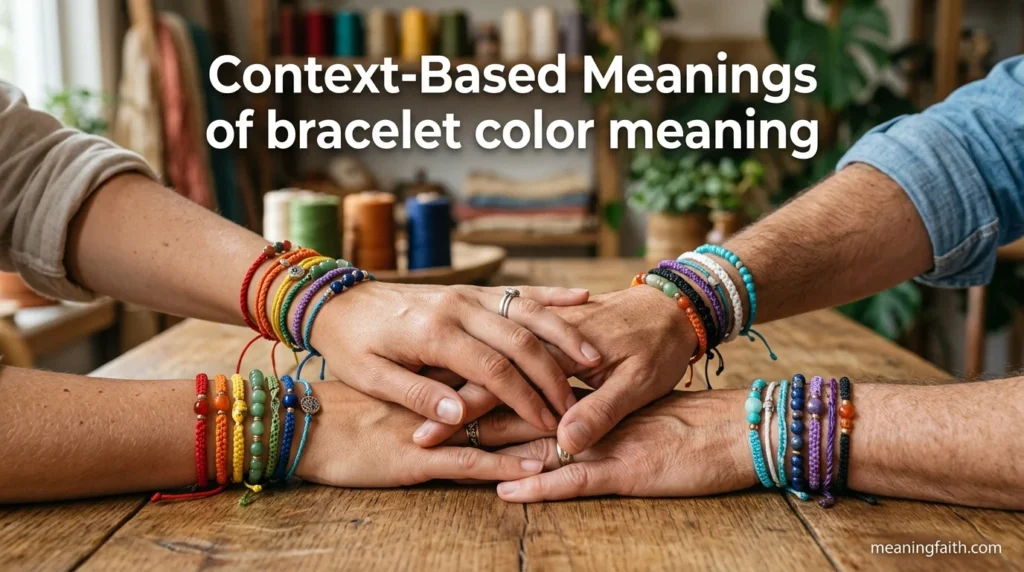
The meaning of a bracelet color changes depending on where it is worn, who wears it, and why it was given. Looking at different contexts helps explain why the same bracelet can carry completely different messages.
Personal Expression
Many people wear colored bracelets as daily reminders of personal goals or emotions. A green bracelet may encourage personal growth, while a blue bracelet can remind someone to stay calm during stressful situations. These meanings are deeply personal and may never be obvious to others.
Someone beginning a new career might wear a yellow bracelet as a reminder to stay optimistic. Another person may choose white during a period of healing or fresh beginnings. In these situations, the bracelet serves as a private symbol rather than a public statement.
Relationships and Friendship
Bracelets are frequently exchanged as meaningful gifts. Friendship bracelets remain one of the best-known examples, representing trust, shared memories, and long-lasting bonds.
Couples sometimes wear matching bracelets using complementary colors. Red and black combinations may symbolize strength and commitment, while pink and white can represent affection and honesty. Family members may also exchange bracelets to celebrate milestones or maintain emotional connections across long distances.
Spiritual Practice
Many meditation practitioners wear bracelets during prayer or mindfulness exercises. In this context, the color becomes part of a spiritual routine rather than a fashion choice.
For example:
- Purple may represent wisdom or spiritual awareness.
- Blue encourages inner peace and reflection.
- Green symbolizes healing and compassion.
- White reminds the wearer of clarity and simplicity.
Even if the bracelet itself has no religious significance, it can become a meaningful habit that reinforces positive intentions each day.
Fashion and Style
In fashion, bracelet color meaning is often flexible. Stylists frequently recommend choosing colors that complement clothing, seasons, or skin tones rather than symbolic traditions.
Neutral colors like black, brown, gray, and white work with almost any outfit. Bright colors such as turquoise, coral, or yellow create contrast and attract attention. Designers may intentionally mix colors to create unique visual effects without intending any symbolic message at all.
Understanding the surrounding context prevents misunderstandings and highlights how versatile bracelet colors have become in modern society.
Color / Design / Style Variations
While individual cultures interpret colors differently, several color meanings appear consistently across many traditions. These broad associations help explain why certain bracelet colors remain popular around the world.
Red is commonly associated with love, courage, determination, passion, and protection. It is often worn during celebrations or important life events.
Blue usually symbolizes calmness, trust, honesty, wisdom, and emotional balance. Many people choose blue bracelets when seeking peace or stability.
Green represents growth, health, renewal, prosperity, and a close connection to nature. It is also popular among people focusing on personal development.
Yellow reflects happiness, confidence, creativity, curiosity, and optimism. Bright yellow bracelets often create an energetic appearance.
Purple is connected with spirituality, imagination, wisdom, and personal transformation. It frequently appears in meditation jewelry.
White symbolizes purity, hope, innocence, forgiveness, and fresh beginnings. It is often chosen for ceremonies or meaningful milestones.
Black can represent elegance, strength, determination, protection, or remembrance. Although sometimes misunderstood as negative, black is also one of the most versatile fashion colors.
Pink is associated with kindness, compassion, friendship, affection, and emotional warmth. It remains especially popular in handmade friendship bracelets.
Design influences meaning as well. A braided bracelet often emphasizes relationships and craftsmanship. Beaded bracelets may highlight gemstones or symbolic numbers, while minimalist metal bracelets usually express timeless elegance. Charms, engraved messages, and mixed-color patterns add additional layers of symbolism beyond color alone.
Common Misconceptions About bracelet color meaning
Many people assume every bracelet color has one universal definition, but that is one of the biggest misconceptions surrounding bracelet symbolism.
The first misunderstanding is that colors mean exactly the same thing everywhere. In reality, cultural traditions differ considerably. White may symbolize weddings in one country and mourning in another. Red can represent celebration, protection, romance, or sacrifice depending on historical and cultural context.
Another misconception is that bracelet colors have supernatural powers. While some spiritual traditions believe certain bracelets offer protection or blessings, many religious leaders emphasize that the bracelet itself is simply a symbol of faith or intention rather than a magical object.
People also mistakenly believe that every awareness bracelet represents the same cause worldwide. Numerous charities use identical colors, meaning the organization or accompanying message is often more important than the bracelet color alone.
Fashion trends create additional confusion. A celebrity may wear a purple bracelet purely because it matches an outfit, not because it symbolizes spirituality. Likewise, someone wearing a black bracelet is not necessarily expressing sadness or grief.
Finally, many assume handmade friendship bracelets always follow fixed color meanings. In practice, the creator often chooses colors based on shared memories, favorite sports teams, school colors, or personal preferences instead of traditional symbolism.
Recognizing these misconceptions encourages a more thoughtful interpretation of bracelet color meaning and respects both cultural traditions and individual expression.
How to Use bracelet color meaning in a Sentence
Learning how to use the phrase naturally makes conversations and writing clearer. Here are several examples that show different contexts.
- “Before buying a gift, I researched bracelet color meaning to choose a color that represented friendship.”
- “She selected a green bracelet because its color meaning reminded her of growth and new opportunities.”
- “Our teacher explained bracelet color meaning while discussing symbols used in different cultures.”
- “Many travelers enjoy learning bracelet color meaning before purchasing handmade jewelry from local artisans.”
- “Although traditions vary, understanding bracelet color meaning helps avoid misunderstandings when giving symbolic gifts.”
These examples show that the phrase is commonly used when discussing symbolism, fashion, culture, religion, or personal expression rather than describing the bracelet itself.
Frequently Asked Questions About bracelet color meaning
What does bracelet color meaning mean?
Bracelet color meaning refers to the symbolism or message associated with the color of a bracelet. Depending on the culture, religion, personal intention, or occasion, a bracelet’s color may represent emotions, spiritual beliefs, relationships, awareness causes, or personality traits. There is no single universal meaning, so context always plays an important role.
What is the origin of bracelet color meaning?
The tradition dates back thousands of years to ancient civilizations such as Egypt, India, China, and Greece, where colors were believed to carry symbolic and spiritual significance. As bracelets became popular forms of jewelry, people began using colored beads, threads, gemstones, and metals to express protection, status, faith, and personal beliefs.
What does bracelet color meaning mean in spiritual traditions?
In many spiritual traditions, bracelet colors serve as reminders of values rather than magical objects. In Hinduism, sacred threads may symbolize blessings or protection, while Buddhist bracelets often encourage mindfulness and compassion. Modern spiritual practices also associate bracelet colors with the chakra system and personal growth.
Is bracelet color meaning positive or negative?
Bracelet color meaning is generally neutral. Most colors have positive symbolism, but their interpretation depends on culture and circumstance. For example, black may represent elegance, strength, or remembrance, while white may symbolize purity in some cultures but mourning in others. Understanding the cultural background helps avoid incorrect assumptions.
What is the difference between bracelet color meaning and gemstone meaning?
Bracelet color meaning focuses on the symbolism of the bracelet’s color, whereas gemstone meaning relates to the traditional beliefs connected with a specific stone. For instance, two green bracelets may share the same color but have different symbolic associations if one contains jade and the other contains emerald or glass beads.
What does bracelet color meaning symbolize?
Bracelet color meaning can symbolize friendship, love, courage, hope, healing, spirituality, wisdom, protection, creativity, or personal transformation. The exact symbolism depends on the color, the bracelet’s purpose, and the traditions or experiences of the person wearing it.
Why do people wear bracelets with specific colors?
People wear specific bracelet colors to express their personality, celebrate friendships, support awareness campaigns, honor cultural traditions, strengthen spiritual practices, or simply because a particular color has personal significance. In many cases, the bracelet serves as a daily reminder of an important goal, memory, or value.
Related Searches & Topics
Many people researching bracelet color meaning also want to understand friendship bracelet color meanings. While some color combinations have traditional interpretations, most friendship bracelets gain their significance from the relationship between the people exchanging them rather than from fixed color rules.
Another common search involves bracelet colors for luck. Red, green, and gold frequently appear in traditions associated with prosperity, protection, and good fortune. However, the meanings differ between cultures, so the same color may symbolize different forms of luck around the world.
Readers also search for chakra bracelet meanings. Chakra bracelets typically combine seven colors that correspond to energy centers described in ancient Indian philosophy. Many people wear them during meditation or mindfulness practices as personal reminders of balance and well-being.
A related topic is awareness bracelet colors. Different nonprofit organizations use colored wristbands to support health conditions, social causes, and charitable campaigns. Because several organizations share the same colors, identifying the specific campaign is often more accurate than relying on color alone.
Another popular search is gemstone bracelet meanings. Unlike color symbolism alone, gemstone bracelets combine the traditional meaning of the stone with the symbolism of its color. This creates additional layers of personal and cultural significance for many wearers.
Conclusion
Bracelet colors have carried symbolic meaning for centuries, connecting fashion, history, spirituality, and personal expression. A single bracelet may represent friendship, faith, healing, celebration, remembrance, or support for an important cause, depending on its color and the context in which it is worn. While many meanings are rooted in ancient traditions from cultures around the world, modern interpretations have made bracelet symbolism more personal than ever.
Understanding bracelet color meaning allows you to appreciate both its historical background and its modern uses. Rather than assuming every color has one fixed definition, it is helpful to consider cultural traditions, personal intention, and the occasion on which the bracelet is worn. Which meaning of bracelet color meaning resonates most with you?

Daniel Matthews is a Bible researcher and Christian writer with a passion for explaining biblical terms, names, symbols, and theological concepts in simple language. He specializes in Old Testament studies, Hebrew word meanings, and biblical symbolism, helping readers better understand Scripture and its historical context.