The silly meaning refers to the way the word “silly” is understood in different contexts, ranging from harmless fun to mild foolishness in the English language. In modern usage, especially in platforms like TikTok and among Gen Z speakers, “silly meaning” can shift depending on tone, emotion, and social setting. Linguistics and semantics show that “silly” is not just a simple adjective but a flexible word shaped by culture and time.
Historically, the word has evolved from serious meanings in Old English and Middle English into a softer, more playful term today. Dictionaries such as the Oxford English Dictionary and Merriam-Webster highlight this transformation clearly. Even writers like William Shakespeare used “silly” in ways that differ from today’s casual interpretation, showing how language changes across centuries.
silly meaning means: The term “silly meaning” refers to the interpretation of the word “silly,” which generally describes lighthearted foolishness, harmless behavior, or playful actions. It is shaped by context, tone, and culture within the English language, and documented in sources like the Oxford English Dictionary.
Origin & History of silly meaning
The silly meaning has deep historical roots in the evolution of the English language. In Old English, the word “silly” originally meant “happy,” “blessed,” or “innocent.” It came from the term sælig, which had spiritual and positive associations. Over time, through Middle English, the meaning shifted toward “pitiable” or “weak,” reflecting changing social attitudes.
By the time Early Modern English developed, writers like William Shakespeare began using “silly” to describe foolish or simple-minded behavior. This shift marks a major semantic change studied in linguistics and semantics. The Oxford English Dictionary documents this evolution in detail, showing how meanings drift across centuries.
Today, the silly meaning is mostly lighthearted, often referring to playful behavior rather than insult. This change shows how pragmatics and cultural usage reshape words. Merriam-Webster also notes this transition as part of natural language development in the English language, especially in the United Kingdom and beyond.
Primary Meaning of silly meaning
The primary silly meaning today refers to something playful, humorous, or lacking seriousness. In modern English language usage, it often describes actions that are not dangerous but slightly foolish or entertaining. Linguistics explains this as a semantic narrowing, where older serious meanings fade and softer meanings dominate.
In semantics, “silly” is classified as a mild evaluative adjective. It does not carry strong negativity like “stupid” or “ridiculous.” Instead, it suggests harmless fun or innocence. Pragmatics plays a role here because tone and context decide whether “silly” is affectionate or slightly critical.
Dictionaries like Merriam-Webster define the modern silly meaning as “lacking good sense but in a charming or harmless way.” This reflects how English speakers in the United Kingdom and globally use it in everyday speech. The word is now commonly used in casual conversations, especially among younger speakers and Gen Z communities.
Cultural Meanings of silly meaning
The silly meaning varies across cultures, even within English-speaking regions. In the United Kingdom, “silly” can be mildly teasing but still friendly, often used among friends or family. In the United States, it leans more toward playful behavior, especially in informal contexts.
Cultural linguistics shows that meaning is shaped by social norms. In some communities, calling someone “silly” is affectionate, while in others it may imply immaturity. This difference is studied in pragmatics, which focuses on how context changes interpretation.
Pop culture, especially TikTok, has expanded the silly meaning into a positive identity. Gen Z users often describe themselves as “silly” to express authenticity, humor, or emotional openness. This reflects a broader cultural shift where language becomes more expressive and less judgmental.
Even historical literature shows cultural variation. William Shakespeare used “silly” differently depending on character tone, showing how flexible the word has always been in English language history.
Spiritual / Religious Meaning (if applicable)
The silly meaning does not have a strong direct religious definition, but historical linguistics reveals indirect spiritual roots. In Old English, sælig was connected to blessedness or spiritual happiness. This early meaning suggests a positive emotional or even divine state.
In religious texts translated during Middle English, words related to “silly” were sometimes used to describe innocence or purity of heart. Over time, however, the meaning drifted away from spirituality into everyday speech.
In modern interpretation, some people still associate “silly” with innocence, which can indirectly connect to moral or spiritual purity. However, this is more cultural than doctrinal. Neither the Oxford English Dictionary nor Merriam-Webster assigns a religious meaning today.
Thus, while the silly meaning once had spiritual undertones, it is now primarily secular and used in casual communication within the English language.
Slang / Modern Usage (if applicable)
In modern slang, especially on TikTok and Gen Z platforms, the silly meaning has become more expressive and identity-based. People use “silly” to describe themselves when they are being goofy, emotional, or playful in a relatable way.
Unlike older formal usage, slang usage of “silly” is often positive. It can signal friendliness, openness, or humor. Pragmatics explains this as a shift in tone where meaning depends heavily on context and relationship between speakers.
On social media, calling someone “silly” can be affectionate, similar to saying “you’re funny” or “you’re adorable in a chaotic way.” This reflects how internet culture reshapes semantics in real time.
Even in informal speech in the United Kingdom and other English-speaking regions, “silly” has softened over time. Instead of insult, it often signals warmth, showing how language evolves through social interaction.
Context-Based Meanings of silly meaning
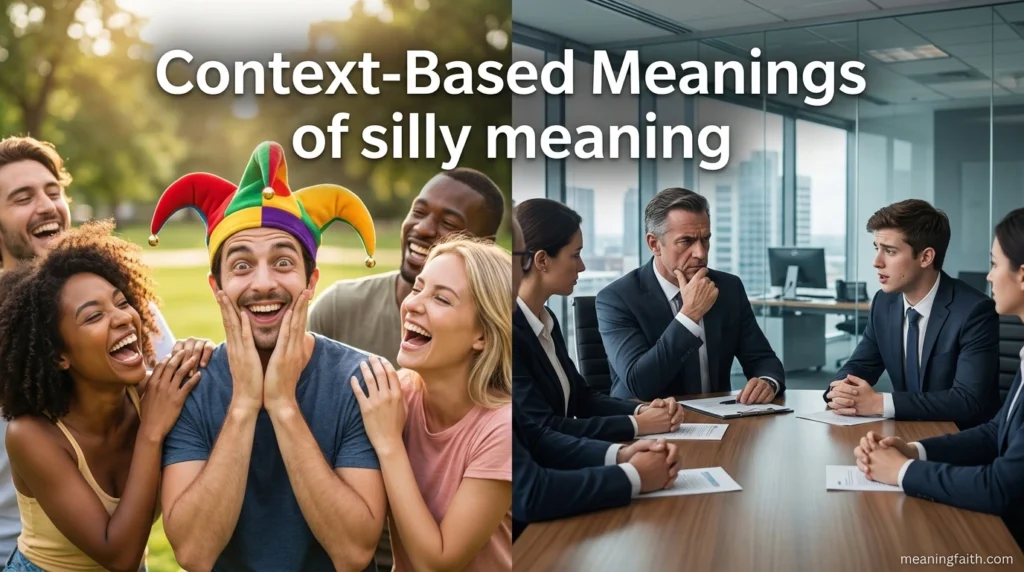
The silly meaning changes depending on context. In at least three major contexts, the interpretation shifts significantly:
In emotional contexts, “silly” can mean affectionate teasing, often used between close friends or family members. It suggests warmth rather than criticism.
In behavioral contexts, it describes light foolishness, such as joking around or acting without serious intent. Linguistics classifies this as a low-intensity evaluative term.
In digital contexts, especially on TikTok, “silly” becomes a personality trait. Gen Z users may call themselves “silly” to express humor, relatability, or emotional openness.
Semantics and pragmatics both show that context determines whether the silly meaning is positive, neutral, or mildly critical. Even historical usage in Middle English demonstrates that context has always influenced interpretation.
Color / Design / Style Variations (if applicable)
While the silly meaning is not directly linked to color or design, it appears in branding and digital aesthetics. On platforms like TikTok, “silly” is often associated with bright colors, playful fonts, and animated visuals that reflect humor and creativity.
In design psychology, playful styles often use soft curves, pastel tones, and cartoon-like elements to match the emotional tone of “silly.” This aligns with semantic associations where meaning extends beyond language into visual culture.
In modern internet culture, especially among Gen Z, “silly aesthetics” are used in memes, stickers, and digital art. This shows how linguistics can influence design trends indirectly.
Thus, while not a formal category, the silly meaning has become part of visual expression in digital environments.
Common Misconceptions About silly meaning
One common misconception is that the silly meaning is always negative. In reality, modern usage is often positive or affectionate. Dictionaries like Merriam-Webster confirm that it is rarely used as a strong insult today.
Another misconception is that “silly” means the same as “stupid.” Semantically, this is incorrect. “Stupid” is harsher, while “silly” is softer and often playful.
Some believe the word has always meant foolishness, but historical evidence from Old English shows it originally meant blessed or happy. The Oxford English Dictionary documents this shift clearly.
Finally, people sometimes assume context does not matter, but pragmatics proves that tone, relationship, and situation completely change the silly meaning.
How to Use silly meaning in a Sentence (3–5 examples)
- You are being silly meaning you are joking around instead of focusing on your work.
- Her silly meaning of dancing in the rain made everyone laugh.
- Stop being silly meaning don’t act without thinking during the meeting.
- On TikTok, calling yourself silly meaning you are embracing playful energy.
- His silly meaning behavior reminded me of childhood games.
Frequently Asked Questions About silly meaning
What does silly meaning mean?
The silly meaning refers to the interpretation of the word “silly,” which generally describes playful, lighthearted, or mildly foolish behavior. It is not strongly negative in modern English language usage. Instead, it often conveys harmless fun or affection depending on context and tone.
What is the origin of silly meaning?
The silly meaning originates from Old English sælig, which meant happy or blessed. Over time, through Middle English, it shifted toward weak or foolish behavior. The Oxford English Dictionary traces this evolution clearly through centuries of linguistic change.
What does silly meaning mean in modern slang?
In modern slang, especially on TikTok and among Gen Z users, silly meaning refers to being playful, goofy, or emotionally expressive. It is often used positively to describe someone who is fun or relatable rather than foolish in a negative sense.
Is silly meaning positive or negative?
The silly meaning is usually positive or neutral in modern usage. While it can sometimes be mildly critical depending on tone, most English speakers use it affectionately. Pragmatics shows that context determines whether it feels friendly or slightly teasing.
What is the difference between silly meaning and stupid?
The silly meaning is softer and often playful, while “stupid” is harsher and more insulting. Semantics distinguishes them clearly: “silly” suggests harmless fun, whereas “stupid” implies lack of intelligence or poor judgment.
What does silly meaning symbolize?
The silly meaning often symbolizes innocence, humor, and emotional openness. In cultural contexts, it represents a willingness to be playful or not take life too seriously. In digital culture, it also symbolizes authenticity and relatability.
Why do people use silly meaning?
People use the silly meaning to express humor, affection, or light teasing. It helps soften communication and build social connection. In modern English language use, especially online, it has become a way to show friendliness and emotional ease.
Related Searches & Topics
The word “silly meaning in English language” is often searched by learners who want simple definitions and examples. It connects closely with semantics and pragmatics because meaning depends on context and tone in everyday speech.
Many users also explore “silly meaning in slang,” especially on platforms like TikTok. Here, Gen Z usage shows how digital culture reshapes traditional English language meanings into more playful expressions.
Another common query is “silly meaning in United Kingdom English,” where usage can be slightly more teasing compared to American English. Cultural linguistics helps explain these subtle regional differences.
Searches like “silly meaning in Middle English” appear from users interested in history. This reflects how the word evolved from Old English sælig, showing a major semantic shift over time.
People also look up “silly meaning vs stupid meaning” to understand differences in intensity. Linguistics and semantics clearly show that “silly” is softer and more affectionate than “stupid.”
Conclusion
The silly meaning has evolved from ancient expressions of happiness in Old English to a modern playful and affectionate term in everyday English language use. Influenced by linguistics, semantics, and cultural shifts, it now carries mostly lighthearted or humorous tones. Whether in historical texts or modern TikTok conversations, the word adapts easily to context and emotion.
Understanding the silly meaning helps reveal how language changes across time, culture, and social interaction. Which meaning of silly meaning resonates most with you?

Ethan Reynolds is a researcher and writer at MeaningFaith.com, focusing on spiritual meanings, signs, and symbolic interpretations. His work combines careful research with practical explanations, making complex topics easier to understand for readers seeking meaningful answers.