Mien meaning refers to a person’s appearance, facial expression, manner, or overall bearing, especially the impression they create through their posture, expression, and behavior. Although the word is not commonly used in everyday conversation, it frequently appears in literature, formal writing, and dictionaries such as the Oxford English Dictionary and Merriam-Webster. Understanding this term helps readers appreciate subtle descriptions of appearance, demeanor, and personality that writers use to paint vivid character portraits.
Unlike words that describe only physical looks, mien combines outward appearance with attitude and expression. Someone may have a confident mien, a gentle mien, or even a mysterious mien. The word captures the overall feeling a person projects rather than a single facial feature or emotion. Learning its meaning also improves vocabulary and reading comprehension, particularly when exploring classic novels, biographies, and historical texts where descriptive language plays a central role.
mien meaning means: Mien refers to a person’s overall appearance, facial expression, posture, and manner that together create an impression of their character or attitude. Derived from the French language, the word is commonly used in literature and formal English to describe someone’s outward bearing rather than simply their physical appearance.
Origin & History of mien meaning
The history of mien stretches back several centuries. The English word entered the language during the late sixteenth century from the French language, where mine referred to appearance, expression, or bearing. French itself developed the term from older linguistic roots connected with facial expression and outward presentation.
Early English writers embraced the word because it conveyed more than physical beauty. Instead of focusing on clothing or facial features alone, mien described the complete impression a person gave. This broader meaning made it especially valuable in poetry, essays, and novels.
Many classic authors used the word to create memorable characters. Rather than stating that a person looked brave or wise, writers described a noble or calm mien, allowing readers to imagine the character’s presence through subtle details.
Modern dictionaries, including Merriam-Webster and the Oxford English Dictionary, continue to define mien as a person’s appearance or manner, particularly one that suggests character. Although less common in casual speech today, the word remains important in literature, academic writing, and historical texts. Its continued use demonstrates how language preserves expressive words that communicate complex ideas with remarkable precision.
Primary Meaning of mien meaning
The primary meaning of mien centers on the impression a person creates through their appearance and behavior combined. It is not simply about how someone looks. Instead, it reflects posture, facial expression, confidence, attitude, and the overall image presented to others.
Imagine meeting two people wearing similar clothing. One stands tall, smiles warmly, and speaks calmly. The other appears tense and avoids eye contact. Their physical appearance may be similar, but their mien differs greatly.
This distinction makes the word especially useful when describing character without directly stating personality traits. A confident mien suggests authority. A cheerful mien implies friendliness. A stern mien may indicate seriousness or discipline.
The concept also connects closely with first impression. People naturally form opinions based on someone’s bearing before conversation begins. Mien captures this immediate visual and emotional impression in a single word.
Unlike “appearance,” which often focuses on physical features, mien combines visual cues with behavior. This makes it richer and more expressive than many common alternatives.
Because of this layered meaning, the word remains popular among writers who seek precise vocabulary. It offers readers a fuller understanding of how someone presents themselves and how others perceive them.
Cultural Meanings of mien meaning
Different cultures interpret a person’s mien through their own traditions, values, and expectations. Although the dictionary definition remains consistent, cultural standards influence what people consider respectful, confident, or welcoming.
In many East Asian cultures, a calm and composed mien often reflects self-control and respect. Maintaining steady posture and measured facial expressions may communicate maturity and wisdom.
In several Western cultures, an open smile and direct eye contact frequently contribute to a friendly mien. These behaviors are commonly associated with honesty and confidence during social interactions.
Professional settings around the world also value an appropriate mien. Business leaders, diplomats, teachers, and public speakers often develop a composed bearing that inspires trust and credibility. Their appearance, posture, and communication style work together to shape public perception.
The study of etiquette further highlights the importance of outward bearing across societies. Historical etiquette manuals frequently discussed posture, expressions, and graceful movement because these qualities influenced how individuals were judged.
Literature from different countries often reflects these cultural expectations. Authors use descriptions of a character’s mien to reveal social status, education, confidence, or emotional state without lengthy explanations. This subtle storytelling technique remains effective across languages and cultures.
Spiritual / Religious Meaning
Although mien has no direct religious definition, many spiritual traditions recognize the importance of outward bearing as a reflection of inner character.
In Christianity, humility, kindness, and peace are often expected to appear in one’s conduct and expression. Religious artwork frequently portrays saints with serene expressions and gentle bearing, reinforcing this connection between inner faith and outward appearance.
Buddhist teachings similarly emphasize calmness and mindfulness. A peaceful mien may symbolize emotional balance and compassion rather than external beauty.
Across many faith traditions, people believe that genuine character eventually becomes visible through expressions, posture, and daily behavior. This idea aligns naturally with the meaning of mien, which reflects more than physical appearance.
Religious leaders often cultivate a respectful demeanor during ceremonies and public gatherings. Their composed bearing helps communicate wisdom, patience, and sincerity.
Rather than carrying symbolic religious meaning itself, the word serves as a useful description of how spiritual qualities may become visible through facial expressions and conduct. This makes mien relevant in religious literature, biographies, and historical accounts where outward appearance reflects deeper moral values.
Slang / Modern Usage
Mien is not considered slang. Instead, it belongs to formal or literary English and appears far less often in everyday conversation than words such as “look,” “vibe,” or “presence.”
Modern speakers usually express similar ideas with phrases like “confident vibe,” “professional presence,” or “friendly appearance.” However, these expressions do not fully capture the elegant precision of mien.
Contemporary writers still use the word in historical fiction, fantasy novels, biographies, and formal journalism. Readers often encounter it when authors wish to create a refined or classical tone.
Social media rarely uses mien, although literature enthusiasts, editors, and vocabulary learners occasionally discuss it when exploring uncommon English words.
Because the word sounds sophisticated, it sometimes appears in academic writing or book reviews describing historical figures or fictional characters.
Although uncommon in casual conversation, understanding mien helps readers interpret advanced texts more accurately. Recognizing the word also expands vocabulary and improves appreciation of descriptive writing, making it valuable despite its relatively limited everyday use.
Context-Based Meanings of mien meaning
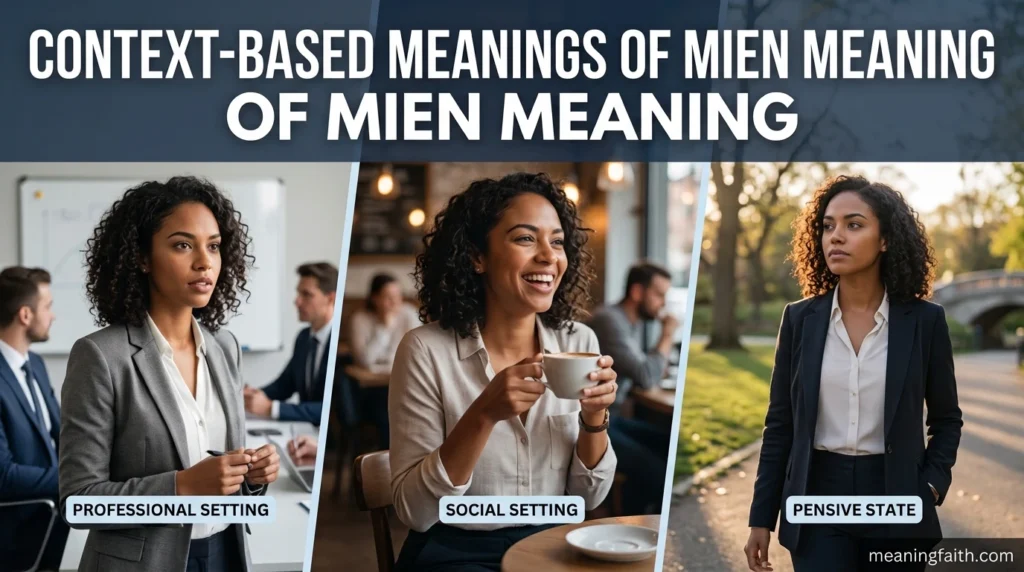
The meaning of mien changes slightly depending on the context, while always referring to outward bearing.
Literature
In novels and poetry, mien often describes a character’s personality through appearance and expression. Authors use it to create vivid mental images without directly explaining emotions.
Professional Communication
In workplaces, a confident mien suggests competence, leadership, and professionalism. Recruiters and managers may notice someone’s bearing during interviews even before conversation begins.
Historical Writing
Biographers frequently describe the mien of historical leaders, scholars, or military figures to illustrate authority or dignity. Such descriptions help readers imagine how these individuals were perceived by others.
Daily Social Interaction
In everyday life, someone’s friendly mien may encourage conversation, while a stern mien might make them appear unapproachable. This demonstrates how appearance and demeanor influence human relationships.
Across each context, the underlying meaning remains consistent: mien refers to the overall impression created by appearance, facial expression, posture, and behavior working together.
Color / Design / Style Variations
Unlike symbols, flowers, or gemstones, mien does not have official color or design variations. However, visual style strongly influences the impression that a person’s mien creates.
Clothing choices, posture, grooming, and facial expressions all contribute to perceived bearing. Dark formal clothing may support a serious or authoritative mien, while bright colors and relaxed posture often create a welcoming impression.
Design professionals sometimes discuss visual presentation in similar terms when considering branding or public image. A carefully designed appearance can reinforce confidence and professionalism.
Personal style also shapes how others interpret demeanor. Minimalist fashion may communicate discipline, while artistic clothing choices may suggest creativity.
Body language plays an equally important role. Standing upright, maintaining appropriate eye contact, and displaying natural facial expressions often strengthen a positive impression regardless of clothing.
Although mien itself has no symbolic colors or styles, the surrounding visual elements significantly influence how a person’s overall bearing is perceived.
Common Misconceptions About mien meaning
One common misconception is that mien simply means face. While facial expression contributes to a person’s mien, the word includes posture, behavior, and overall appearance as well.
Another misunderstanding is that mien always describes attractiveness. In reality, someone may have an impressive mien regardless of physical beauty. The focus lies on the overall impression rather than appearance alone.
Some readers believe the word is outdated or obsolete. Although less common today, respected dictionaries continue to recognize and define it, and authors still use it in literature and formal writing.
Others confuse mien with personality. Personality refers to enduring internal characteristics, whereas mien describes the outward expression of those characteristics.
Finally, some assume the word has negative meaning because it often appears in dramatic novels. In fact, mien is neutral. It can describe positive, negative, or ordinary impressions depending on the accompanying adjective, such as cheerful, solemn, confident, or reserved.
How to Use mien meaning in a Sentence
Using mien correctly becomes easier after seeing practical examples.
- The teacher’s calm mien reassured nervous students before the examination.
- Despite the unexpected news, she maintained a confident mien throughout the meeting.
- The old king entered the hall with a noble mien that commanded immediate respect.
- His cheerful mien made everyone feel welcome at the gathering.
- The detective observed the stranger’s guarded mien before asking any questions.
In each sentence, mien refers to the overall impression created through appearance, facial expression, posture, and behavior rather than physical features alone.
Frequently Asked Questions About mien meaning
What does mien meaning mean?
Mien means a person’s overall appearance, facial expression, bearing, or manner that reveals something about their character or attitude. It describes the impression someone creates through posture, expression, and conduct rather than simply their physical features.
What is the origin of mien meaning?
The word entered English from the French language during the late sixteenth century. It originally referred to appearance or expression and gradually developed into its modern meaning of outward bearing and demeanor, a definition still recognized by leading dictionaries today.
What does mien mean in literature?
In literature, mien helps authors describe characters without lengthy explanations. A single phrase such as “a noble mien” or “a fearful mien” allows readers to imagine personality, confidence, or emotional state through outward appearance and behavior.
Is mien positive or negative?
Mien is a neutral word. Its meaning depends entirely on the adjective used alongside it. A friendly mien carries a positive meaning, while a hostile mien suggests a negative impression. The word itself does not express approval or criticism.
What is the difference between mien and demeanor?
Mien emphasizes outward appearance, facial expression, and bearing, while demeanor focuses more on behavior and conduct. Although the terms overlap, mien includes visual impression in addition to manner.
What does mien symbolize?
Mien symbolizes the connection between outward appearance and inner character. It often represents confidence, dignity, kindness, authority, or emotional state as perceived through expression, posture, and overall bearing rather than spoken words.
Related Searches & Topics
Many readers also search for the meaning of demeanor because it shares similarities with mien. While both describe how someone presents themselves, demeanor emphasizes behavior more than appearance.
Another common search is bearing meaning. Bearing refers primarily to posture and conduct, making it closely related to mien. Both words frequently appear in formal writing and historical biographies.
People interested in vocabulary often compare mien with countenance. Countenance usually refers to facial expression, whereas mien includes posture, expression, and overall presence.
Searches for appearance vs personality also relate naturally to mien. The word bridges these ideas by describing how personality becomes visible through outward presentation without claiming to define someone’s true character.
Readers exploring classic novels frequently look up archaic English words after encountering mien. Although uncommon today, it remains an accepted and meaningful part of modern English vocabulary.
Conclusion
Understanding mien meaning reveals that the word describes much more than physical appearance. It combines facial expression, posture, demeanor, and overall bearing into a single idea that reflects the impression a person creates.
From its French origins to its continued use in literature and formal English, mien remains a precise and expressive term. Whether describing a confident leader, a gentle friend, or a mysterious fictional character, the word

Grace Anderson is a contributor at MeaningFaith.com who specializes in dream meanings, symbolism, and personal growth topics. She is dedicated to creating informative and reader-friendly content that helps people explore the deeper meanings behind everyday experiences and spiritual concepts.