The corresponding angles meaning refers to pairs of angles that occupy the same relative position when a transversal crosses two lines, especially parallel lines. In geometry, corresponding angles help explain relationships between angles and are commonly used to solve problems involving parallel lines, shapes, and measurements.
Students usually learn corresponding angles in geometry classes when studying lines and angles. The concept is connected with important ideas from Euclidean geometry, where mathematicians study points, lines, shapes, and the relationships between them.
Understanding corresponding angles is useful because it provides a simple way to identify equal angle measurements. When a transversal crosses two parallel lines, corresponding angles are congruent, meaning they have the same measure. This rule allows students, engineers, architects, and designers to calculate unknown angles accurately.
Whether you are learning basic geometry or reviewing mathematical concepts, knowing how corresponding angles work makes many angle problems easier to understand. The key idea is recognizing the matching position of angles created by intersecting lines.
Featured Snippet
corresponding angles meaning: Corresponding angles are pairs of angles formed when a transversal crosses two lines and appear in the same relative position. When the two lines are parallel, corresponding angles are equal in measure. They are used in geometry to identify angle relationships and solve measurement problems.
Origin & History of corresponding angles meaning
The history behind corresponding angles meaning comes from the development of geometry as a mathematical discipline. The study of lines, angles, and shapes dates back thousands of years, with early contributions from civilizations such as Ancient Egypt and Ancient Greece.
The foundation of modern geometry is strongly connected to Euclid, a mathematician who lived around 300 BCE. His work, often called Elements, organized many geometric principles into a logical system. Although the exact term “corresponding angles” developed later, the ideas behind angle relationships were part of the geometric principles studied by Euclid.
Ancient mathematicians explored how lines interact and how measurements can be predicted using logical rules. These discoveries became important in architecture, astronomy, engineering, and land measurement.
The concept became especially important after mathematicians studied parallel lines and transversals more deeply. A transversal creates several angle pairs, and recognizing patterns between these angles allows mathematicians to create reliable theorems.
The historical development of corresponding angles shows how geometry evolved from practical measurement techniques into a structured mathematical system. Today, the concept remains a basic but essential part of geometry education.
Modern applications include:
- Architectural planning
- Engineering designs
- Computer graphics
- Construction measurements
- Scientific modeling
The same principles discovered through classical geometry continue to help solve real-world problems involving direction, alignment, and spatial relationships.
Primary Meaning of corresponding angles meaning
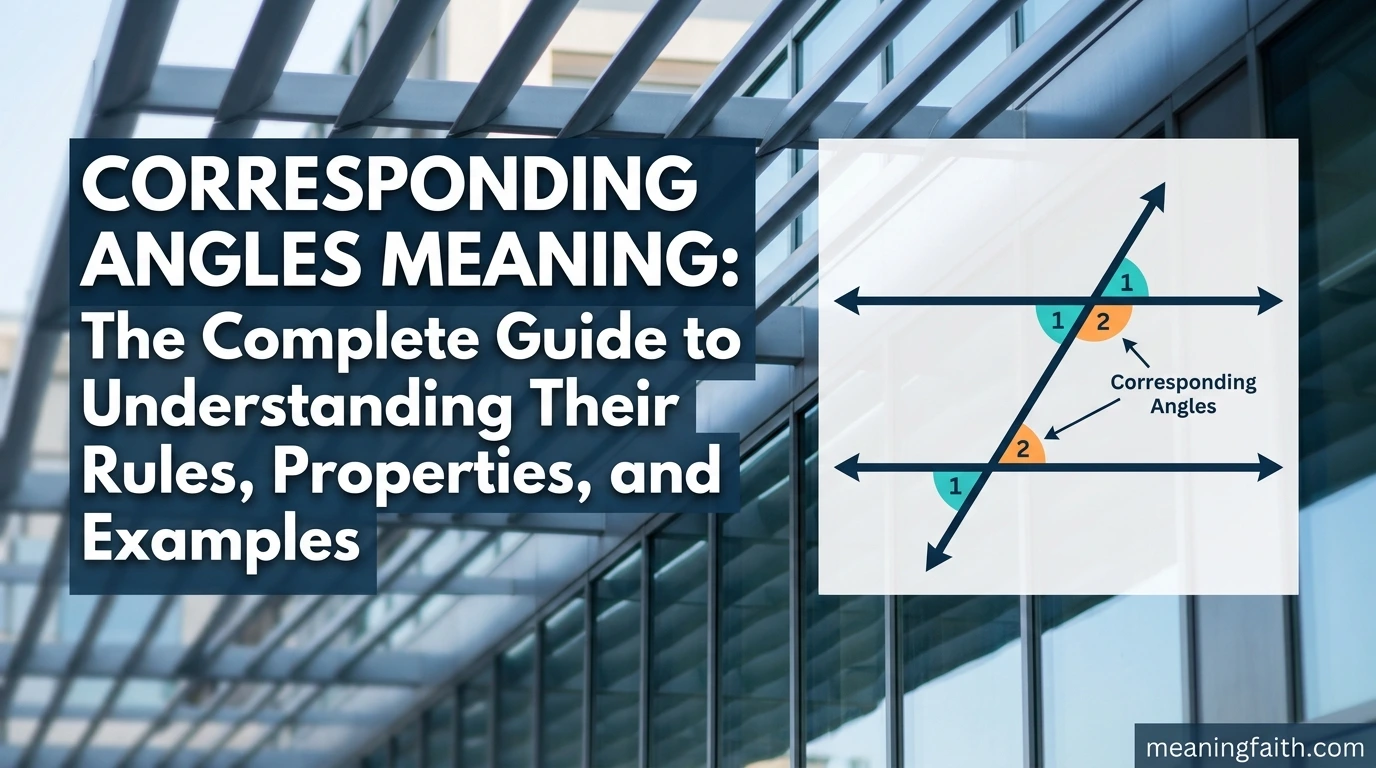
The primary corresponding angles meaning is based on position rather than just size. Corresponding angles are created when a line called a transversal crosses two other lines. The angles are considered corresponding when they appear in matching positions at each intersection.
Imagine two parallel lines crossed by a diagonal line. The transversal creates four angles at the first intersection and four angles at the second intersection. The angles that occupy the same corner position are corresponding angles.
For example:
- The top-right angle at the first intersection corresponds to the top-right angle at the second intersection.
- The bottom-left angle at the first intersection corresponds to the bottom-left angle at the second intersection.
When the two crossed lines are parallel, corresponding angles have equal measurements. This relationship is called the corresponding angles theorem.
The main properties of corresponding angles include:
- They are formed by a transversal crossing two lines.
- They have the same relative position at each intersection.
- They are equal when the lines are parallel.
- They help identify unknown angle measurements.
However, corresponding angles are not always equal. The equality rule depends on the lines being parallel. If the two lines are not parallel, the angles may have different measurements even though they occupy matching positions.
The concept is important because it gives mathematicians a shortcut. Instead of measuring every angle separately, they can use known relationships to determine missing values.
Cultural Meanings of corresponding angles meaning
Unlike words that have cultural, spiritual, or symbolic meanings, corresponding angles meaning is primarily mathematical. However, geometry itself has played an important role in human culture throughout history.
Geometry has influenced architecture, art, science, and design across many civilizations. Ancient societies used geometric principles to create buildings, patterns, and structures that required accurate measurements.
For example, geometric ideas involving lines and angles were used in:
- Ancient Egyptian construction
- Greek architectural designs
- Islamic geometric patterns
- Modern engineering projects
The relationship between angles also appears in visual design. Artists and architects use geometric balance to create symmetry, proportion, and harmony.
The concept of corresponding angles reflects a broader human interest in order and relationships. Just as corresponding angles show connections between different parts of a diagram, geometry often helps people understand patterns in the physical world.
In education, learning corresponding angles also develops logical thinking. Students practice identifying relationships, comparing measurements, and applying rules to solve problems.
Although corresponding angles do not have a traditional cultural meaning, their role in mathematics has contributed to many cultural achievements. From historical buildings to modern technology, geometric principles continue to shape how humans design and understand their surroundings.
Spiritual / Religious Meaning of corresponding angles meaning
Corresponding angles meaning does not have a specific spiritual or religious definition because it is a mathematical concept. It describes a relationship between angles created by lines and does not represent a belief, symbol, or religious teaching.
However, geometry has appeared in spiritual and religious architecture throughout history. Many sacred buildings use geometric principles to create patterns, structures, and designs.
Examples include:
- Symmetrical layouts in temples and churches
- Decorative geometric patterns in Islamic art
- Mathematical proportions in historical architecture
These uses show how geometry can have symbolic importance in human creativity. Shapes, symmetry, and balance are often associated with ideas such as harmony and order.
The concept of corresponding angles can also be viewed symbolically as an example of relationships and connections. Two angles correspond because they share a similar position in a larger structure. This reflects a broader idea that different parts of a system can have meaningful relationships.
Still, the true meaning of corresponding angles remains mathematical. Its purpose is to explain angle relationships and provide a reliable method for solving geometry problems.
Slang / Modern Usage of corresponding angles meaning

The corresponding angles meaning does not have a slang definition because it is a formal mathematical term used in geometry. Unlike internet expressions or casual language, corresponding angles are used mainly in classrooms, textbooks, engineering discussions, and technical fields.
In modern education, the phrase is commonly used by students and teachers when discussing geometry problems. A student might ask, “How do I find corresponding angles?” while solving a problem involving parallel lines and a transversal.
Technology has also changed how people learn this concept. Online learning platforms, digital whiteboards, and geometry software allow students to visualize corresponding angles more easily. Instead of only looking at diagrams on paper, learners can manipulate lines and observe how angle relationships change.
Modern uses of corresponding angles include:
- Digital geometry lessons
- Computer-aided design programs
- Engineering drawings
- Architectural models
- Mathematical simulations
In professional settings, engineers and designers use geometric relationships to create accurate plans. Although they may not frequently use the phrase in everyday conversation, the principle behind corresponding angles helps maintain correct measurements and alignment.
The modern understanding of corresponding angles remains closely connected to visual learning and problem-solving. The concept shows how mathematical language provides a precise way to describe relationships between shapes, lines, and measurements.
Context-Based Meanings of corresponding angles meaning
The interpretation of corresponding angles meaning depends on the situation where the term is used. While the basic definition remains the same, different fields apply the concept in different ways.
Corresponding angles meaning in geometry
In geometry, corresponding angles are angle pairs created by a transversal crossing two lines. Their most important feature is their matching position.
When the two lines are parallel, corresponding angles are congruent. This means they have identical measurements.
For example, if one corresponding angle measures 65 degrees, the matching corresponding angle also measures 65 degrees.
This rule is often written as:
If two parallel lines are cut by a transversal, corresponding angles are equal.
Students use this relationship to find unknown angle values and prove geometric statements.
Corresponding angles meaning in mathematics education
In schools, corresponding angles are part of lessons about angle relationships and geometric reasoning. Teachers introduce this topic after students understand basic concepts such as:
- Lines and line segments
- Acute and obtuse angles
- Parallel and intersecting lines
- Angle measurement
Learning corresponding angles helps students develop logical thinking. Instead of relying only on measurement tools, they learn to use mathematical rules.
Many geometry exercises involve identifying pairs of angles and explaining why they are equal. This builds skills used later in advanced mathematics.
Corresponding angles meaning in engineering and architecture
Engineers and architects use geometric principles when creating accurate designs. Corresponding angles help professionals understand alignment between different parts of a structure.
For example, when creating a building blueprint, designers need lines and angles to match correctly. The relationship between parallel surfaces and repeated structures depends on accurate geometric calculations.
Computer-aided design software also relies on mathematical relationships to create precise models.
Corresponding angles meaning in coordinate geometry
In coordinate geometry, corresponding angles can help analyze shapes placed on a coordinate plane. When lines are transformed, rotated, or compared, angle relationships provide information about their position and direction.
Mathematicians use these ideas when studying transformations such as:
- Reflections
- Rotations
- Translations
- Scaling
Understanding corresponding angles makes it easier to analyze how geometric objects relate to each other.
Color / Design / Style Variations of corresponding angles meaning
Corresponding angles meaning does not have official color symbolism because it is a mathematical idea rather than a visual symbol. However, colors are often used in educational materials and diagrams to make corresponding angles easier to recognize.
In geometry diagrams, different colors may highlight matching angle pairs. For example, a textbook may use the same color for two corresponding angles to show that they occupy the same relative position.
Designers and educators often use visual techniques such as:
- Matching colors for related angles
- Highlighting transversal lines
- Labeling angle pairs
- Using arrows to show parallel lines
These design choices improve understanding because geometry depends heavily on visual relationships.
In architecture and technical drawing, geometric patterns often rely on balanced angles and repeated structures. Although corresponding angles are not a style element themselves, the principle supports designs where alignment and symmetry are important.
Digital learning tools may also use animation and interactive graphics to demonstrate how corresponding angles work. By moving a transversal or changing line positions, students can see when angle relationships remain valid.
The visual representation of corresponding angles is therefore about clarity rather than symbolism. Colors, diagrams, and digital models help learners recognize the relationship between angles quickly.
Common Misconceptions About corresponding angles meaning
Many students misunderstand corresponding angles because several angle relationships appear similar in geometry. Knowing the differences helps prevent common mistakes.
One common misconception is that corresponding angles are always equal. This is not completely true. Corresponding angles are equal only when the two lines crossed by the transversal are parallel.
If the lines are not parallel, the angles may have different measurements even though they appear in matching positions.
Another misunderstanding is confusing corresponding angles with alternate interior angles. Both involve a transversal, but their positions are different.
The differences include:
- Corresponding angles occupy the same relative position.
- Alternate interior angles are located between the lines on opposite sides of the transversal.
- Vertical angles are opposite each other at the same intersection.
Some learners also think the term refers to angles that simply look alike. However, position is the key feature. Two angles correspond because of where they are located, not because they appear visually similar.
Common mistakes include:
- Forgetting to check whether lines are parallel
- Matching the wrong angle pair
- Confusing interior and exterior angles
- Measuring instead of applying geometric rules
A strong understanding of the definition makes solving angle problems much easier.
How to Use corresponding angles meaning in a Sentence
The phrase corresponding angles meaning is mainly used in educational or explanatory writing. Here are examples showing how it can appear naturally:
- “The corresponding angles meaning explains why two angles have equal measurements when a transversal crosses parallel lines.”
- “Students learned the corresponding angles meaning before solving advanced geometry problems.”
- “The teacher used a diagram to demonstrate the corresponding angles relationship between two parallel lines.”
- “Understanding corresponding angles helps engineers create accurate designs and technical drawings.”
- “The corresponding angles theorem allows mathematicians to find missing angle measurements without using a protractor.”
These examples show that the phrase is typically used when explaining geometry concepts. In normal conversation, people may simply say “matching angles” or “equal angles,” but the formal term corresponding angles is preferred in mathematics.
Frequently Asked Questions About corresponding angles meaning
What does corresponding angles meaning mean?
Corresponding angles meaning refers to pairs of angles that are located in the same relative position when a transversal crosses two lines. If the two lines are parallel, these angles have equal measurements. They are an important concept in geometry because they help identify relationships between angles and solve mathematical problems.
What is the origin of corresponding angles meaning?
The origin of corresponding angles meaning comes from the study of geometry, especially the work of ancient mathematicians such as Euclid. The concept developed through the study of lines, angles, and parallel relationships. Modern geometry uses corresponding angles as part of theorems involving transversals and parallel lines.
What do corresponding angles mean in geometry?
In geometry, corresponding angles are matching angle pairs formed when a transversal intersects two lines. They are identified by their similar positions at each intersection. When the lines are parallel, corresponding angles are congruent, meaning they have the same angle measurement.
Are corresponding angles always equal?
No, corresponding angles are not always equal. They are equal only when the two lines crossed by the transversal are parallel. If the lines are not parallel, corresponding angles may have different measurements even though they appear in matching positions.
What is the difference between corresponding angles and alternate angles?
The difference is based on position. Corresponding angles are in the same relative position at two intersections, while alternate angles are on opposite sides of the transversal. Both relationships are used in geometry, but they describe different angle arrangements.
What do corresponding angles symbolize?
Corresponding angles symbolize relationships and consistency within geometric structures. They show how different parts of a figure can have predictable connections. In mathematics, they represent order, balance, and logical relationships between lines and angles.
Why do people use corresponding angles?
People use corresponding angles because they make geometry problems easier to solve. Instead of measuring every angle individually, mathematicians, students, engineers, and designers can use angle relationships to calculate unknown values and create accurate models.
Related Searches & Topics
People searching for corresponding angles meaning may also search for “corresponding angles theorem” because this rule explains why corresponding angles are equal when a transversal crosses two parallel lines. The theorem is one of the basic principles students use to solve geometry problems involving unknown angle measurements.
Another related search is “corresponding angles examples,” where learners look for diagrams and practical demonstrations. Examples help students identify matching angle positions and understand how a transversal creates different angle relationships.
Many users also search for “corresponding angles and parallel lines” because parallel lines are essential to the equality rule. Without parallel lines, corresponding angles may not have the same measurement, which is why checking line relationships is an important step.
The phrase “corresponding angles vs alternate angles” is another common topic. Both involve a transversal crossing two lines, but they describe different positions and relationships between angle pairs.
Students may also search for “corresponding angles worksheet” to practice identifying angle pairs and calculating missing values. Worksheets are commonly used in mathematics classrooms to strengthen geometry skills.
Conclusion
Corresponding angles are an important part of geometry because they explain how angle relationships work when a transversal crosses two lines. The corresponding angles meaning focuses on angles that occupy the same relative position, especially when parallel lines create equal angle measurements.
This concept helps students understand geometric patterns and gives professionals such as engineers and designers a reliable way to work with measurements and structures. While corresponding angles do not have cultural or symbolic meanings, they represent order, balance, and logical relationships within mathematics.
Learning how to identify corresponding angles makes many geometry problems easier by replacing guesswork with proven rules. Which meaning of corresponding angles meaning resonates most with you?

Grace Anderson is a contributor at MeaningFaith.com who specializes in dream meanings, symbolism, and personal growth topics. She is dedicated to creating informative and reader-friendly content that helps people explore the deeper meanings behind everyday experiences and spiritual concepts.