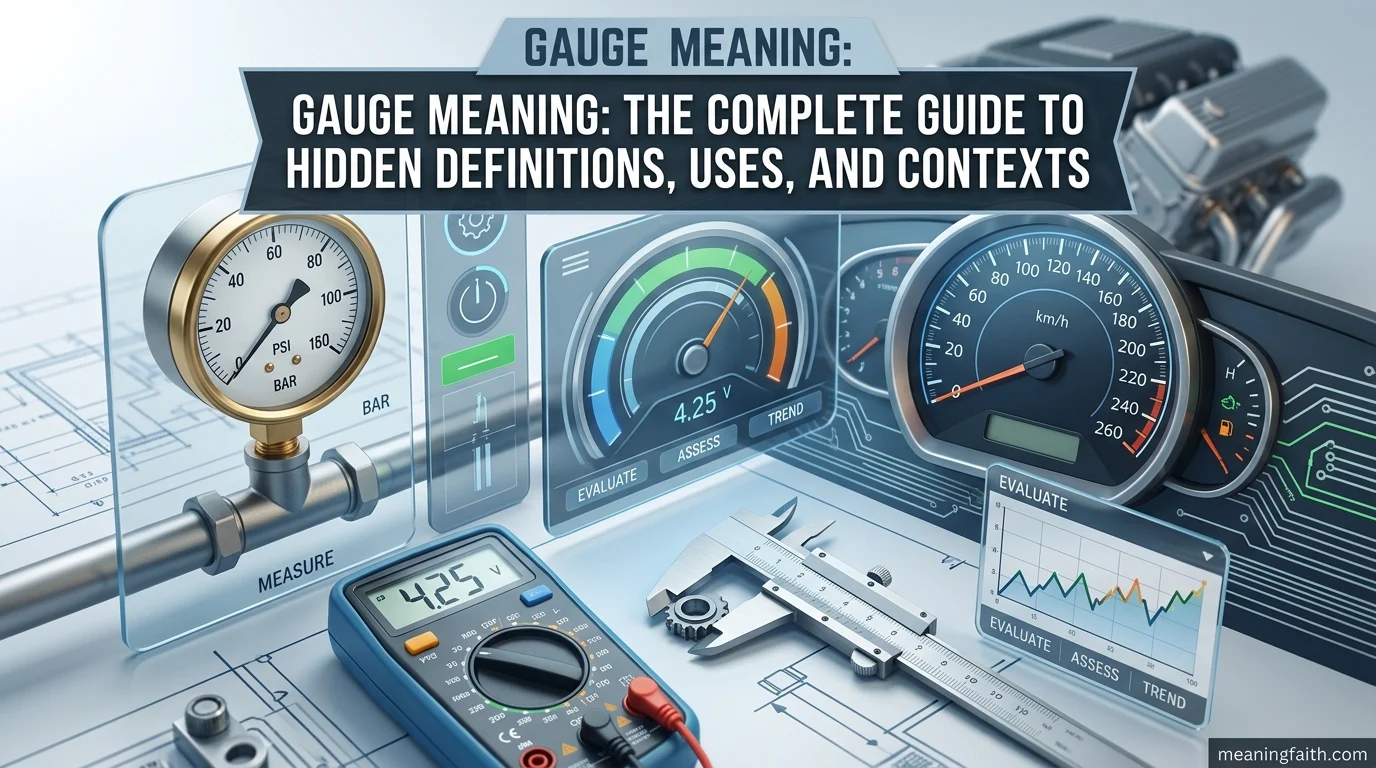
The gauge meaning refers to a term used in measurement, language, and everyday tools to describe size, thickness, or level. In simple terms, gauge is a way to measure or estimate something, whether it is air pressure in a tire, the width of railway tracks, or even the quality of metal sheets in Engineering contexts. The word appears in both technical fields like Physics measurement and practical tools like a Pressure gauge.
In linguistics, “gauge” can also mean to judge or assess something, which connects it to Semantics and interpretation of meaning. This makes the term flexible and widely used across industries and communication. From industrial machines to everyday conversations, “gauge” carries both literal and figurative meanings.
Understanding the gauge meaning helps you interpret technical instructions, mechanical readings, and even metaphorical expressions in English.
gauge meaning means: The term “gauge meaning” refers to the idea of measurement, estimation, or assessment using a tool or system called a gauge. It can describe physical measurement devices like a Pressure gauge for tire pressure, or conceptual usage where it means to judge or evaluate something. It is widely used in Engineering, Physics measurement, and everyday language to indicate size, level, or quality.
Origin & History of gauge meaning
The word “gauge” traces back to Old French jauge, meaning a standard measure, and even earlier to Germanic roots related to “yardstick” or measuring tools. Historically, it became important in trade and construction, where accurate measurement was essential. During the medieval period in Europe, standardized measurement systems began forming, influencing modern Metrology.
In industrial history, the concept of gauge expanded significantly during the Industrial Revolution. Machines required precise calibration, leading to instruments like the Dial indicator for mechanical precision. Engineers used gauges to ensure uniform production in factories, railways, and construction.
Over time, “gauge” also entered abstract language use, shifting from physical tools to mental estimation. Today, it is used in both technical and linguistic contexts, showing how deeply it is tied to human measurement systems and communication practices.
Primary Meaning of gauge meaning
The primary gauge meaning is “to measure or estimate.” In physical sciences, it refers to instruments that measure quantities such as pressure, thickness, or distance. A common example is a Pressure gauge used in vehicles or industrial systems to check fluid or air pressure.
In engineering, gauge also refers to standard dimensions. For example, metal sheets are categorized by thickness using gauge numbers. Similarly, railway tracks use a specific width known as a Railway gauge, which ensures compatibility between trains and infrastructure.
In everyday usage, “to gauge” means to estimate or judge something, such as gauging public opinion or emotional reactions. This figurative use connects physical measurement with human judgment, making the word highly versatile across fields.
Cultural Meanings of gauge meaning
Culturally, the gauge meaning reflects precision, control, and evaluation. In industrial societies like the United States, United Kingdom, and Germany, gauges symbolize technological advancement and accuracy in manufacturing systems. The idea of measurement is deeply connected to trust in machines and systems.
In communication, “gauge” is often used metaphorically to describe understanding human behavior. For example, “gauge the mood of the crowd” reflects social awareness rather than physical measurement. This shows how language evolves from technical roots into cultural expression.
In craftsmanship traditions, such as tailoring and woodworking, tools like the Sewing gauge represent precision and skill. These cultural uses highlight how measurement is not only scientific but also artistic, blending functionality with human creativity.
Spiritual / Religious Meaning of gauge meaning
While “gauge” is not a spiritual term in most religions, its conceptual meaning of measurement can symbolize balance, judgment, and awareness. In philosophical traditions, measurement is often associated with truth and order, especially in ancient Greek thought where proportion represented harmony.
In modern spiritual interpretations, “gauging oneself” can mean self-reflection or assessing personal growth. This aligns with internal evaluation practices found in mindfulness traditions.
Religious texts rarely use the word directly, but the idea of judgment and evaluation connects loosely to moral accountability. Thus, the gauge meaning can metaphorically represent inner balance and self-assessment rather than physical measurement.
Slang / Modern Usage of gauge meaning
In modern slang, “gauge” is sometimes used informally to mean “to figure out” or “to understand quickly.” For example, “I’m trying to gauge the situation” means assessing what is happening.
In technical communities, especially engineering and automotive fields, “gauge” still strongly refers to measurement tools. Mechanics frequently check tire pressure using a Pressure gauge or evaluate mechanical alignment using precision instruments.
Digital environments also use the term metaphorically. Data analysts “gauge performance” using metrics and dashboards, showing how the concept has expanded into modern analytics and decision-making systems.
Context-Based Meanings of gauge meaning
The gauge meaning changes depending on context:
1. Engineering Context
In Engineering, gauge refers to measurement tools or standard sizes. It ensures consistency in production and design.
2. Physics Context
In Physics measurement, it describes instruments used to measure force, pressure, or dimensions accurately.
3. Transportation Context
In rail systems, Railway gauge defines the distance between tracks, affecting train compatibility and safety.
4. Linguistic Context
In Semantics, “gauge” means to interpret or estimate meaning in communication.
5. Scientific Theory Context
In Gauge theory, it refers to advanced physics frameworks explaining fundamental forces.
These contexts show how flexible the word is across disciplines.
Color / Design / Style Variations of gauge meaning
Although “gauge” is not a visual concept, it appears in design and manufacturing standards. In industrial design, gauge numbers represent material thickness, especially in metals and wires. Lower gauge numbers usually mean thicker material.
In measurement design systems under Metrology, precision tools are color-coded or calibrated for clarity. This helps engineers quickly interpret readings.
Tools like the Dial indicator also reflect design precision, with clear markings and dial faces for accurate reading. In this sense, “gauge” influences how measurement tools are visually structured for usability and accuracy.
Common Misconceptions About gauge meaning
A common misconception is that “gauge” only refers to physical tools. In reality, it also means “to estimate or judge,” especially in conversation and analysis.
Another misunderstanding is confusing gauge with exact measurement only. While it can be precise in engineering, it is often used loosely in language, such as “gauging interest,” which is subjective.
Some also think all gauges measure the same thing, but different tools measure different variables like pressure, thickness, or alignment. For example, a Pressure gauge measures fluid force, while a sewing gauge measures fabric spacing.
Understanding these differences clarifies the broad usage of the term.
How to Use gauge meaning in a Sentence
- I need a Pressure gauge to check the tire pressure before driving.
- Teachers often gauge student understanding during lessons.
- Engineers rely on Engineering tools to ensure accuracy in design.
- The technician used a Dial indicator to measure alignment.
- It is difficult to gauge public reaction to the new policy.
Frequently Asked Questions About gauge meaning
What does gauge meaning mean?
The gauge meaning refers to measuring, estimating, or judging something using a tool or mental assessment. It can apply to physical instruments like a Pressure gauge or abstract evaluation like gauging opinions or emotions in communication.
What is the origin of gauge meaning?
The word comes from Old French jauge, meaning standard measure. It evolved through European trade and engineering practices, becoming part of modern Metrology and industrial measurement systems used worldwide today.
What does gauge mean in communication?
In communication, it means to estimate or understand something, such as gauging emotions or reactions. It is closely linked to Semantics, where meaning is interpreted based on context rather than exact measurement.
Is gauge positive or negative?
The term is neutral. It simply refers to measurement or evaluation. Its tone depends on context, such as technical accuracy in Engineering or subjective judgment in social situations.
What is the difference between gauge and measure?
“Measure” usually refers to exact calculation, while gauge can mean estimation or judgment. Gauge is often broader and less precise, especially in everyday language use.
What does gauge symbolize?
Gauge symbolizes precision, awareness, and evaluation. It reflects the human need to understand and quantify both physical and abstract concepts, from Physics measurement to emotional awareness.
Why do people use gauge?
People use gauge to describe tools or mental processes for understanding size, level, or quality. It is widely used in science, engineering, and daily conversation for clarity and assessment.
Related Searches & Topics
The term gauge in measurement tools is often searched alongside pressure systems and mechanical engineering concepts. Many users explore how a Pressure gauge works in vehicles and industrial machines, especially in automotive maintenance.
In transportation systems, Railway gauge is frequently researched to understand how train track widths affect global rail compatibility and safety standards across countries.
The phrase gauge meaning in slang is also popular, especially in modern English usage where people want to understand its figurative meaning in conversations and social media contexts.
Students and engineers often search gauge theory in physics to learn about advanced scientific models that explain fundamental forces in Physics measurement frameworks.
Finally, sewing gauge is a common search among tailoring and fashion enthusiasts who want to understand fabric measurement tools used in design and crafting.
Conclusion
The gauge meaning spans measurement, estimation, and interpretation across science, engineering, and language. It can describe physical tools like Pressure gauge, structural standards like Railway gauge, or abstract judgment in communication. It also connects deeply with Semantics and human understanding of context.
From industrial precision in Engineering to everyday expressions of evaluation, “gauge” remains a versatile and powerful word. Its evolution shows how language blends technical accuracy with human perception.

Grace Anderson is a contributor at MeaningFaith.com who specializes in dream meanings, symbolism, and personal growth topics. She is dedicated to creating informative and reader-friendly content that helps people explore the deeper meanings behind everyday experiences and spiritual concepts.