Non resident alien meaning refers to a person who is not a U.S. citizen and does not qualify as a resident alien under U.S. tax rules. In the United States, the Internal Revenue Service (IRS) uses this classification to determine how someone is taxed, what income must be reported, and which tax forms apply. Although the term sounds like an immigration label, it is primarily a tax classification.
Many people first encounter this phrase while filing taxes, applying for a visa, working in the United States, or studying abroad. Because tax residency and immigration status are not always the same, the term often creates confusion. A person may legally live in the United States on a visa but still be considered a nonresident alien for tax purposes.
Understanding the meaning of this classification helps individuals comply with U.S. tax law, avoid filing mistakes, and understand their rights and obligations.
non resident alien meaning means: a person who is not a U.S. citizen and who does not meet the IRS requirements to be treated as a resident alien for tax purposes. Under U.S. tax law, this status is determined mainly by the Green Card Test or the Substantial Presence Test and affects how income is taxed and reported.
Origin & History of non resident alien meaning
The phrase “nonresident alien” comes from legal and tax terminology developed in the United States during the twentieth century. The word “alien” has long been used in U.S. law to describe someone who is not a U.S. citizen. Although the word may sound unusual in everyday English, it remains a formal legal term in federal statutes.
As international travel, education, and employment increased, lawmakers needed a way to distinguish between foreign nationals who lived in the United States permanently and those who stayed only temporarily. This distinction became especially important for income tax after the federal tax system expanded.
Today, the IRS uses two primary tests to classify tax residency: the Green Card Test and the Substantial Presence Test. These rules help determine whether an individual is taxed on worldwide income or only on certain U.S.-source income.
The term continues to appear on tax forms, official guidance, and legal documents. Although some government agencies increasingly prefer the phrase “non-U.S. citizen” in public communication, “nonresident alien” remains the official legal and tax expression.
Primary Meaning of non resident alien meaning
The primary meaning of a nonresident alien is straightforward. It describes someone who is not a U.S. citizen and who does not qualify as a resident alien under IRS tax rules.
The classification depends on tax residency rather than immigration status alone. Someone may hold a student visa, work visa, or tourist visa and still be considered a nonresident alien for tax purposes.
The IRS generally determines tax residency through two tests:
- The Green Card Test.
- The Substantial Presence Test.
If neither test is met, the person is usually classified as a nonresident alien.
This status affects several important areas:
- Which income must be reported.
- Which deductions and tax credits are available.
- Which tax return must be filed.
- Whether tax treaty benefits apply.
Most nonresident aliens file Form 1040-NR rather than the standard Form 1040 used by resident taxpayers. Their tax obligations often focus on income earned from U.S. sources instead of worldwide income.
Cultural Meanings of non resident alien meaning
Outside legal settings, people sometimes misunderstand the phrase because the word “alien” has different meanings in popular culture. Movies, books, and television frequently use “alien” to describe beings from outer space, making the legal meaning seem unfamiliar or even humorous.
In legal English, however, “alien” simply means a foreign national. This usage dates back centuries in English common law and remains part of U.S. legal vocabulary.
Different countries use different terminology. Canada commonly refers to non-residents for tax purposes. The United Kingdom focuses on residence and domicile rules. Australia also classifies taxpayers according to residency tests rather than citizenship alone.
Understanding these cultural differences is helpful for international students, professionals, and businesses working across borders. Someone familiar with another country’s tax system may assume that citizenship alone determines taxation, but the United States relies heavily on residency tests.
Recognizing the historical legal meaning helps separate the formal definition from everyday cultural associations.
Spiritual / Religious Meaning
The phrase “nonresident alien” has no spiritual or religious meaning in its official use. It is purely a legal and tax classification created by government authorities.
Some religious texts use the words “resident” or “foreigner” to describe people living outside their homeland. For example, the Bible discusses foreigners and sojourners in historical contexts. However, these references are unrelated to the IRS definition.
Likewise, no major religion assigns symbolic meaning to the tax classification itself. Whether someone is a nonresident alien depends entirely on legal standards rather than beliefs or religious identity.
Because the term occasionally appears alongside discussions of immigration, people sometimes search for symbolic interpretations. In practice, professionals in law, accounting, and immigration consistently treat it as an administrative category.
Understanding this distinction prevents confusion between legal terminology and religious language.
Slang / Modern Usage
In everyday conversation, people rarely say “nonresident alien.” Instead, they often shorten it to “NRA,” especially in tax offices, universities, payroll departments, and accounting firms.
For example, a university payroll office may ask whether an international student is an NRA for tax purposes. Human resources staff frequently use the abbreviation when processing employment paperwork.
Outside professional settings, people sometimes mistakenly believe that “nonresident alien” describes immigration status. In reality, someone may have a valid work visa and still qualify as either a resident alien or a nonresident alien depending on IRS rules.
Modern discussions increasingly favor plain-language alternatives such as “non-U.S. resident for tax purposes,” especially in educational materials designed for international visitors.
Despite changing communication styles, the official legal phrase remains widely used on government forms and tax guidance.
Context-Based Meanings of non resident alien meaning
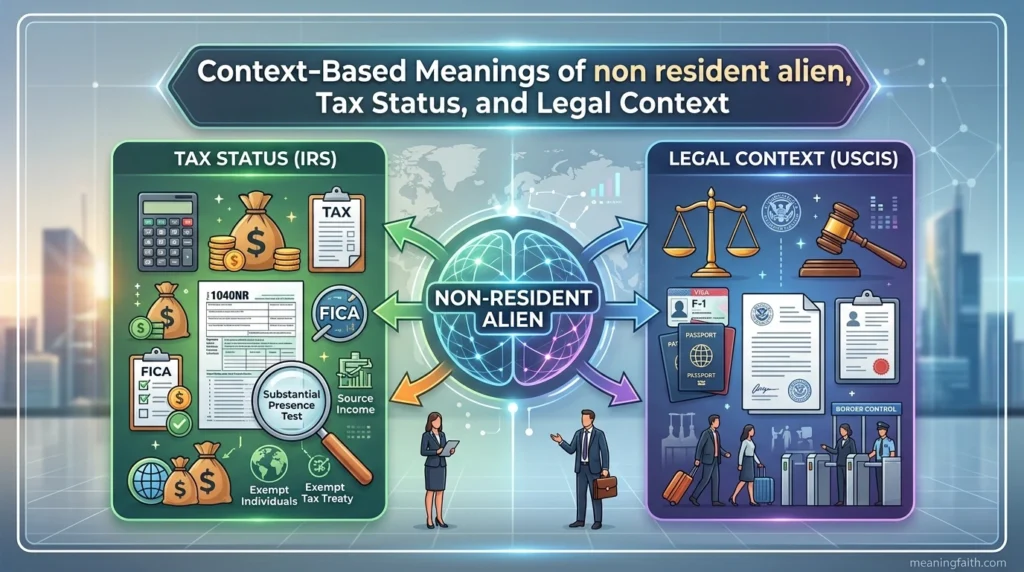
Tax Context
In taxation, a nonresident alien is taxed differently from a resident alien. Generally, only certain U.S.-source income is taxable, although exceptions and tax treaties may apply.
Immigration Context
Immigration agencies focus on visas, lawful status, employment authorization, and permanent residence. Immigration status does not automatically determine tax residency.
Employment Context
Employers must identify whether employees are resident or nonresident aliens because payroll withholding, tax forms, and reporting requirements can differ.
Education Context
International students frequently encounter this classification while completing tax paperwork. Universities often provide guidance because many students remain nonresident aliens during their first years in the United States.
Business Context
Companies hiring foreign workers must understand employee tax classifications to ensure proper withholding and compliance with federal regulations.
These examples show that the meaning changes slightly depending on the context, although the underlying IRS definition remains consistent.
Color / Design / Style Variations
Unlike symbols, logos, or artistic concepts, the term “nonresident alien” has no recognized color, design, or style variations.
Government agencies present the phrase in official documents, tax forms, and instructional publications using standard formatting rather than symbolic design.
Educational websites sometimes highlight resident aliens and nonresident aliens with different colors in charts or diagrams simply to improve readability. These visual choices do not carry legal meaning.
Infographics often compare:
- Resident alien.
- Nonresident alien.
- U.S. citizen.
Such visual aids help explain differences in taxation, filing requirements, and residency tests but should never be interpreted as official classifications.
Therefore, any colors or graphics associated with the term are purely educational and have no legal significance.
Common Misconceptions About non resident alien meaning
One common misconception is that every foreign visitor is automatically a nonresident alien. In reality, someone who passes the Substantial Presence Test may become a resident alien for tax purposes.
Another misunderstanding is that immigration status and tax residency are identical. These are separate legal concepts administered under different rules.
Some people also assume nonresident aliens never pay U.S. taxes. This is incorrect. Many pay taxes on income earned from U.S. sources, including wages, scholarships, business income, or investment income.
Another myth is that citizenship alone determines tax obligations. While citizenship matters, tax residency rules play a major role for non-citizens.
Finally, many believe the word “alien” is informal or insulting. In U.S. federal law, it is simply a technical legal term that continues to appear in statutes and IRS publications.
Understanding these distinctions helps avoid costly filing errors.
How to Use non resident alien meaning in a Sentence
Here are examples showing how the phrase is used correctly:
- The accountant explained the non resident alien meaning before preparing my tax return.
- International students should understand the non resident alien meaning during their first tax season.
- The IRS uses specific residency tests to determine the non resident alien meaning for tax purposes.
- Our payroll department reviewed the non resident alien meaning before calculating withholding taxes.
- Learning the non resident alien meaning helped me understand which tax form I needed to file.
These examples show that the phrase is most commonly used in discussions about taxation, employment, education, and legal compliance.
Frequently Asked Questions About non resident alien meaning
What does non resident alien meaning mean?
It refers to a person who is not a U.S. citizen and who does not qualify as a resident alien under IRS tax rules. The classification determines how income is taxed and which tax forms are required.
What is the origin of non resident alien meaning?
The term developed from U.S. legal language that distinguishes foreign nationals from citizens. It became especially important as federal income tax laws evolved and international travel increased.
What does non resident alien mean in tax law?
In tax law, it identifies someone who generally pays U.S. tax only on certain U.S.-source income unless special rules or tax treaties apply. The Green Card Test and Substantial Presence Test are central to this determination.
Is non resident alien positive or negative?
The term is neutral. It does not describe character, immigration legality, or social status. It is simply a technical classification used by the IRS and other government agencies.
What is the difference between a nonresident alien and a resident alien?
A resident alien meets the Green Card Test or Substantial Presence Test and is generally taxed similarly to U.S. citizens on worldwide income. A nonresident alien usually has different filing rules and tax obligations.
What does non resident alien symbolize?
It does not symbolize a belief or cultural idea. Instead, it represents a legal classification used for tax administration and compliance.
Related Searches & Topics
Many people also search for the difference between a resident alien and a nonresident alien. The key distinction lies in IRS residency tests rather than citizenship alone.
Another common search involves Form 1040-NR. This tax return is generally filed by individuals classified as nonresident aliens for tax purposes.
People also research the Green Card Test and the Substantial Presence Test because these determine tax residency under U.S. law.
International students frequently ask how visas affect tax residency. Student visa holders often remain nonresident aliens during their initial years, depending on IRS rules and exemptions.
Another related topic is tax treaties. The United States has tax agreements with many countries that may reduce or eliminate certain taxes for eligible nonresident aliens.
Conclusion
Understanding non resident alien meaning is essential for anyone dealing with U.S. taxes, international employment, or cross-border education. The term is a legal tax classification rather than an immigration label. It depends primarily on the Green Card Test and the Substantial Presence Test and determines how income is reported and taxed. Knowing the distinction between a resident alien and a nonresident alien helps individuals file correctly, understand their obligations, and avoid common misunderstandings. Which meaning of non resident alien meaning resonates most with you?

Grace Anderson is a contributor at MeaningFaith.com who specializes in dream meanings, symbolism, and personal growth topics. She is dedicated to creating informative and reader-friendly content that helps people explore the deeper meanings behind everyday experiences and spiritual concepts.